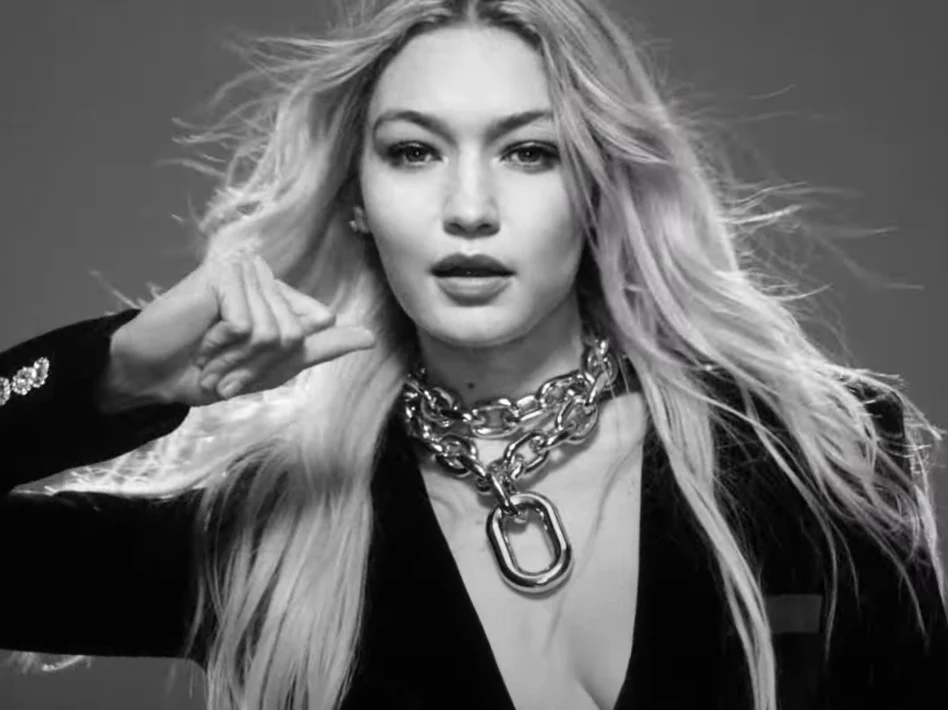
Gigi Hadid’s fashion style offers a useful starting point for anyone who wants comfortable clothes to feel considered. Denim and knitwear are particularly good places to look: familiar garments, made interesting by proportion, colour and the relationship between layers. The aim of this guide is to help you work out what to try, without assuming that a celebrity’s entire wardrobe is a shopping prescription.
There are several different kinds of Gigi imagery: street photographs, runway work, advertising and clothes from her own label. We keep those contexts separate. The real photograph above is a still from a 2024 Rabanne campaign. Its dramatic jewellery and dark tailoring are a commercial styling reference, not a candid record of an everyday outfit.
Start with her own account of denim
In a September 2026 Vogue interview about Guest in Residence’s denim launch, Hadid described jeans and T-shirts as longstanding wardrobe staples. She also discussed adding ballet flats or a skirt while keeping that foundation. The label introduced four denim shapes: Traveler, Everyday, Weekender and Workday. The useful takeaway is continuity: new details can sit alongside clothes already doing their job.
Our starting exercise: choose the jeans you wear most often and photograph three outfits with them. Keep the jeans fixed; change the top or shoes each time. This helps you see whether you actually need another cut, or simply a different way to finish the pair you own. It also makes a new purchase easier to judge: does it fill a distinct role?
Guest in Residence and the knitwear connection
Hadid founded Guest in Residence in 2022 and is its creative director. The brand’s own account traces its beginnings to second-hand cashmere sweaters passed down by her parents. Its range includes sweaters, cardigans and knitted trousers. This is a direct connection between her fashion work and everyday wardrobe categories; it does not mean every knit she wears is from the label.
Try the styling idea in any suitable fibre: lay a fine cardigan over a plain T-shirt, leaving enough room through the armholes for the layers to move together. If the lower layer bunches at the shoulder, change its sleeve shape before changing the size of everything. Cotton, wool or a knit you already own can serve this outfit exercise; cashmere is not a requirement.
Compare the cardigan open, partly buttoned and closed. An open front shows more of the layer underneath, while a closed front creates a larger block of colour. Keep the arrangement that works with the actual weather and your day. For fabric questions, start with our fit and fabrics guides.
Make relaxed proportions look deliberate
A roomy garment does not have to be paired with a tight one. Instead, find a place where the outline becomes clear: a visible cuff, a distinct shoulder seam, an open neckline or a trouser hem that meets the shoe cleanly. Try one adjustment at a time, because several small styling tricks together can start to feel fussy.
With wide jeans and a generous sweater, compare the sweater hanging naturally with a small front tuck. The tuck is optional, and a thick knit may sit more comfortably untucked. Then test the hem with the shoes you will wear. This is about the outline you prefer and freedom of movement, not making your body fit a model’s proportions.
Use our trouser and shoe guide if the bottom of the outfit feels unresolved. Changing footwear can affect the fall of the same trouser leg more than adding another accessory.
Colour without replacing the whole outfit
For a knitwear-and-denim wardrobe, an accent can be as small as the edge of a T-shirt or as large as the sweater itself. Try a pale blue knit with dark brown trousers, or a soft yellow layer beside grey. These are our suggested experiments, rather than reconstructions of a particular Hadid appearance.
Keep two of the garments fixed and compare a neutral third piece with a brighter one. Look at them in daylight. If you like the colour but not the balance, reduce its area: move it from the sweater to a scarf, for example. Our chocolate and ice-blue guide and colour lab show why proportion matters as much as the names of the colours.
What the Rabanne image teaches about accessories
In the campaign still above, chunky chain necklaces occupy the open neckline of a dark jacket. The high contrast makes that area the focal point. It is a useful image to study precisely because its purpose is different from a casual outfit: advertising can concentrate an idea more strongly than you might want for a normal day.
To make a smaller experiment, wear an open-neck shirt with one chain you already own. Compare it with a finer necklace and with no necklace. Keep the shirt and lighting the same. You are testing scale and empty space around the neckline, not trying to reproduce the campaign or imply that a particular product is necessary.
A three-look wardrobe exercise
- An ordinary day: favourite jeans, a T-shirt and a cardigan. Check that every layer is comfortable on its own.
- A longer journey: trousers that remain comfortable seated, a light base layer and a removable knit. Test the waistband and pockets before leaving.
- A more polished variation: keep the jeans, add a jacket and change either the shoes or jewellery. Pause before changing both.
These are original Runway Note outfit suggestions. The point is to find several uses for a small group of clothes, not to claim that Hadid wore each formula. Continue with one garment, five settings, or compare the stronger texture contrasts in our Inde Navarrette style guide.
Sources & further looking
Vogue — Gigi Hadid discusses her denim wardrobe, September 2026Guest in Residence — the brand’s founding and design approachRabanne — Million Gold for Her campaign video, 2024Historical, material and collection references are linked above. Styling exercises and interpretations are our editorial suggestions.
Continue with the celebrity style guides, or read our editorial policy.
.jpg)
