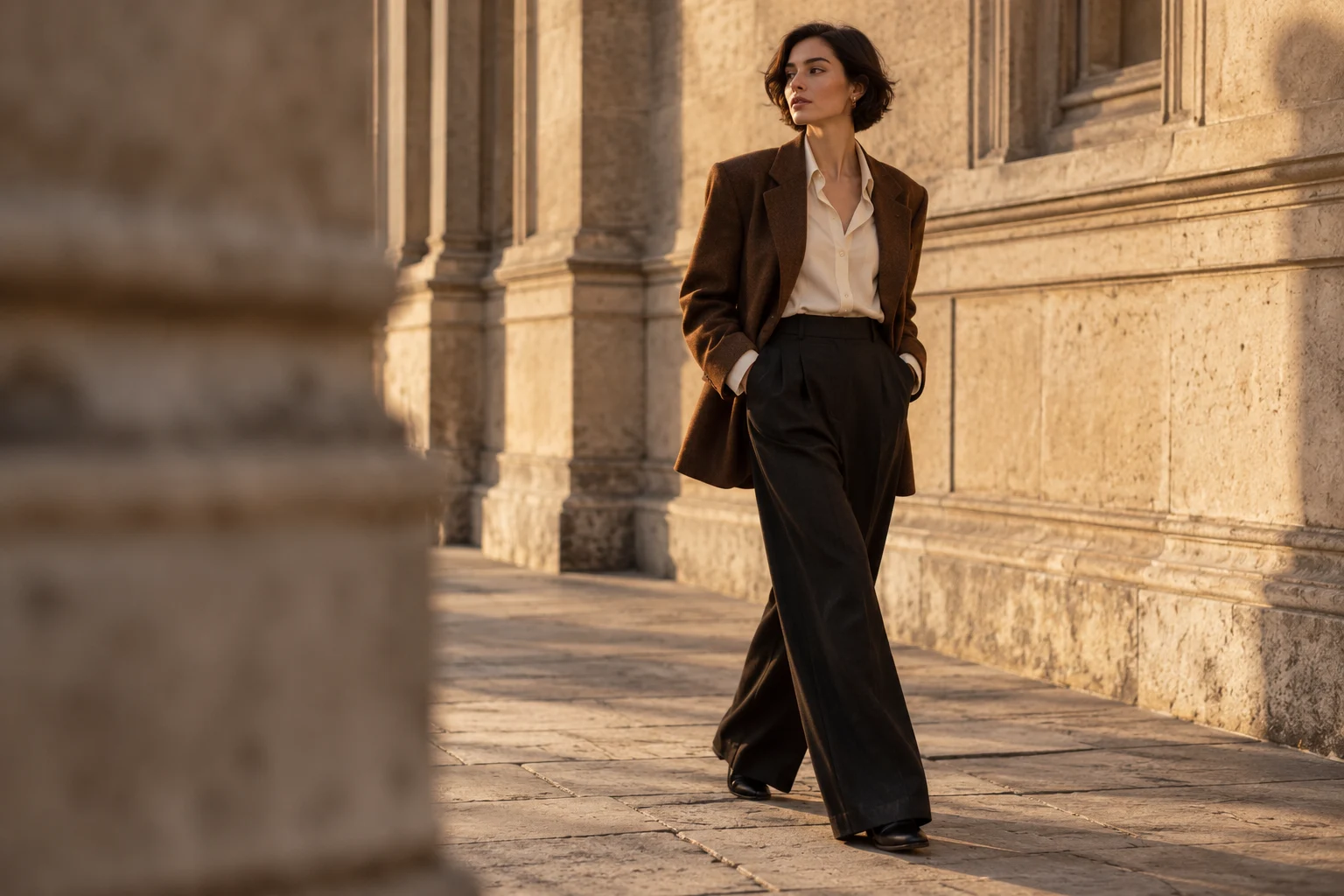
A garment is often described as versatile because it can be photographed with several different accessories. That is a start, but it does not tell you whether it works for your life. A better experiment begins with the settings you actually move through.
Choose one piece and five real uses
Pick a garment you already own and enjoy. Then name five plausible settings: a workday, a long walk with a café stop, a dinner, travel and a family gathering, for example. Replace any setting that does not fit your life. The exercise should not invent occasions to justify the garment.
Five is a useful limit because it creates variety without turning the task into a complete wardrobe audit. If you only need the item for two uses, test those well instead.
Write the practical requirement first
Before adding shoes or jewellery, record what each setting requires. You might need to walk for an hour, sit for a long journey, carry a laptop, remove an outer layer indoors or dress to a host’s specified level of formality. These requirements will often decide more than the colour of an accessory.
| Setting | Practical question | Visual question |
|---|---|---|
| Workday | Can I sit and reach comfortably? | Does the outfit suit this workplace? |
| Walking and a café | Are the shoes and layers useful? | Does the outfit work without the coat? |
| Dinner | Will I be comfortable seated? | What establishes the intended formality? |
| Travel | Can I manage bags and temperature changes? | Does it still feel considered after movement? |
| Gathering | What activities and dress expectations apply? | Does the outfit feel like me in that setting? |
Build with what is already there
Keep the central garment constant and assemble one version for each use. Reuse the same shoes or bag whenever they make sense. The point is to discover workable combinations, not to prove you can create five completely unrelated looks.
Take a simple photograph of each version from the same distance. Include the outer layer in one image and remove it in another if that change will happen during the day.
Give a result, not a score
Use three labels: works as it is, works with a specific adjustment, or does not suit this setting. Write the adjustment precisely. “Needs comfortable walking shoes” is useful; “needs something more fashionable” is not yet a decision you can act on.
A garment that works beautifully in two settings has not failed because it is unsuitable for three others. Specialised clothes can be valuable. The exercise simply prevents a vague promise of versatility from standing in for evidence.
Look for the missing relationship
If several outfits fail for the same reason, the gap may be a relationship rather than a missing trend. You might lack an outer layer of a workable length, a top that sits smoothly beneath a jacket or a comfortable shoe at the right level of formality.
Use that observation before considering a purchase. First test another arrangement with existing pieces. If a gap remains, you have a clearer specification than “something new for the season”.
Keep the record short
Save the successful photographs with a note about weather, setting and any adjustment. Revisit them when the same situation returns. That small personal reference can be more valuable than an enormous folder of outfits that never leave the screen.
For a focused starting point, use one runway idea as the variable you change, then let the practical requirements decide how far it travels.