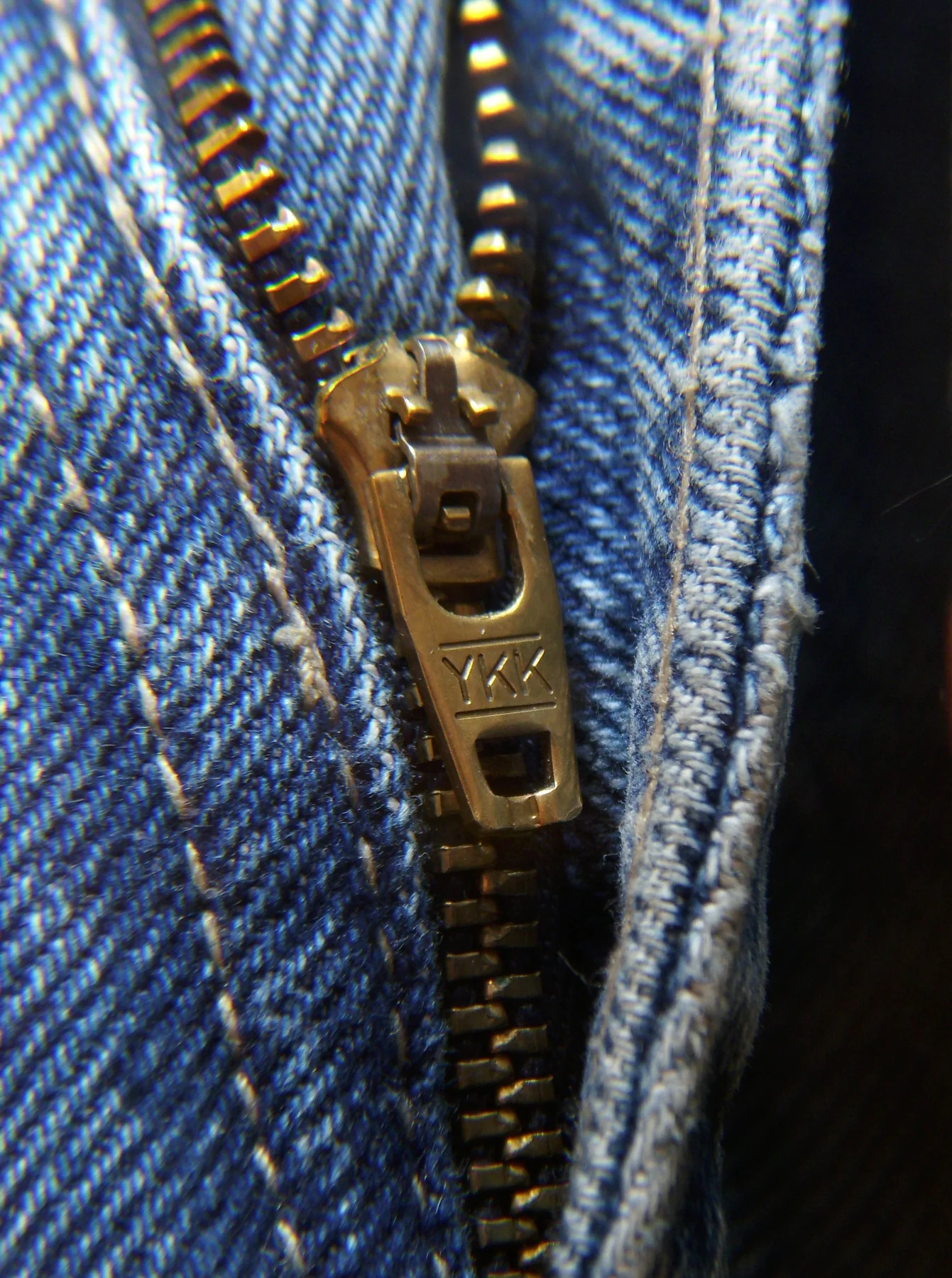
A zipper closes a garment in seconds, so it is easy to imagine that clothing makers adopted the idea as soon as the mechanism worked. The historical sequence was slower. Early slide fasteners proved useful on boots and tobacco pouches before they became ordinary parts of clothes. By the 1930s, designers could still treat an exposed zip as something strikingly modern.
The photograph above is a contemporary macro view of a metal YKK zipper sewn beside denim. It helps show the teeth, slider and fabric tapes, but it is not an image of Gideon Sundback’s patent model or an Elsa Schiaparelli dress. Those historical objects remain linked in the sources.
The mechanism is a small machine on cloth
Gideon Sundback’s United States patent 1,219,881 describes two flexible stringers carrying interlocking members and a sliding operating device. Move the slider one way and the members lock; reverse it and they separate. The patent record lists an application date of 27 August 1914 and publication on 20 March 1917.
This sounds simple only after the geometry has been solved. Each side must remain flexible enough to follow fabric while the interlocking parts meet in a repeatable sequence. The slider has to guide them without adding excessive bulk or allowing the closure to release unintentionally. Sundback’s patent explicitly aimed to reduce weight and bulk while increasing flexibility and security.
The Smithsonian’s National Museum of American History preserves a model associated with Sundback’s Hookless No. 2. Its record notes that interlocking metal teeth first found uses in boots and that B. F. Goodrich is credited with applying the name “zipper.” The same record says the fastener did not become widely used on clothing until the 1930s, including as a replacement for buttons on men’s fly closures.
Why a working invention was not yet a wardrobe standard
A patent can establish a mechanism; it cannot instantly reorganise garment production or taste. Boots and pouches were practical early settings because a fast closure had an obvious job. Clothing raised additional questions: where should the rigid teeth sit against a moving body, how should the ends be secured, should the fastener be visible, and would wearers accept it in place of familiar buttons, hooks or lacing?
The delay between mechanical invention and broad clothing use is therefore part of the design story. It allowed the zipper to move through several roles: specialist closure, utilitarian garment component and, eventually, deliberate decoration. This is not a claim that one designer or one patent single-handedly created every modern zipper. Sundback filed multiple improvements, and manufacturers continued changing materials and production.
Metal teeth become coloured plastic
A V&A conservation study of Schiaparelli garments notes that early zips used metal teeth. After patent protections expired in the early 1930s, companies experimented with plastic versions. The museum identified cellulose nitrate and cellulose acetate zips in Schiaparelli pieces from the later 1930s, evidence that the fastener itself had become an area of material experimentation.
That change mattered visually as well as technically. Metal introduces a line of repeated reflections. Coloured plastic can repeat or interrupt the fabric colour. The V&A’s current Schiaparelli exhibition guide describes a black zip cutting across a Winter 1935 gown and a bright blue plastic zip used prominently on a Spring 1939 dress. In both examples, the fastening was meant to be noticed rather than disguised inside a seam.
Schiaparelli did not merely substitute a zip for buttons. She used the closure to draw across the body. Opening and closing the garment could alter what the viewer saw, making function part of the composition. That move—from hiding the mechanism to emphasising it—is one reason the zipper belongs to fashion history rather than only industrial history.
Hidden, exposed or structural?
On a modern garment, a zipper can take at least three visual roles. A concealed zip tries to let the seam remain the main line. An exposed zip adds contrast through teeth, tape and pull. A structural zip may divide panels, release volume or allow a section to detach. The mechanism is similar, but placement changes the garment’s reading.
Before buying, move the slider slowly rather than yanking it. Check whether fabric or lining enters its path, whether the lower and upper stops feel secure, and whether the seam lies flat when the zip is closed. Sit, bend and raise your arms if the closure crosses an area under tension. A smooth test on an empty hanger does not reveal everything that happens on the body.
Also look inside. The zipper tape should be attached consistently, and the lining should leave enough clearance not to snag. On a close-fitting garment, a heavy exposed zip can affect how a seam hangs; on a coat, the same weight may be visually and physically appropriate. Continue through Runway Note’s fit and fabrics reading route for more ways to connect internal construction with movement.
Read the closure as a line
To see what a zipper contributes, cover it in a photograph with a narrow strip of paper. Does the garment lose a vertical emphasis, a flash of metal or an intentional interruption? Then reveal it again. The exercise separates the closure’s mechanical task from its visual one.
You can do the same with clothes you own. Compare a zipped jacket, a buttoned cardigan and a pullover with similar colour and volume. Notice where each garment creates breaks down the front and how quickly it can change from open to closed. No option is universally superior; the fastener changes both use and appearance.
The zipper’s slow journey into clothing is a reminder that innovation is not complete when a device works. It must be manufactured reliably, placed intelligently and made meaningful to wearers. By the time Schiaparelli turned it into a bright graphic accent, a once-specialised fastener had become a new line for designers to draw with.
Sources & further looking
National Museum of American History — Sundback’s Modern Slide Zipper Patent ModelGoogle Patents — US1219881A, Separable fastenerV&A — Schiaparelli: Fashion Becomes Art, exhibition guideV&A Conservation Journal — Schiaparelli’s plastic zipsHistorical, material and collection references are linked above. Styling exercises and interpretations are our editorial suggestions.
Continue with the style notes guides, or read our editorial policy.