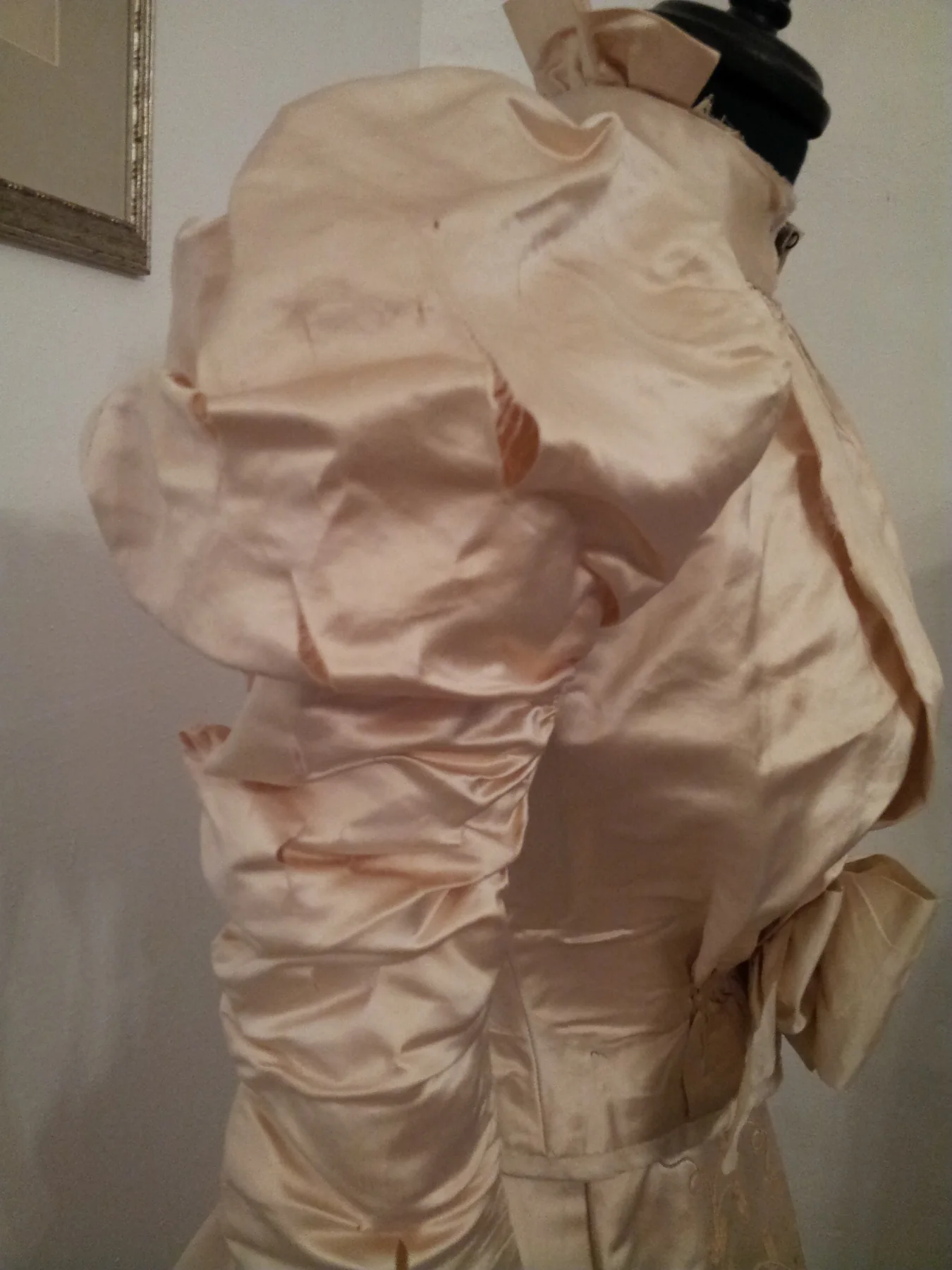
The splits in the wedding dress pictured above do not behave like an ordinary torn seam. Broad sections of silk have broken into narrow, sharp-edged ribbons while embroidery and the garment’s general outline remain visible. Textile conservators call this condition shattered silk. The name describes the brittle, fragmenting appearance; the cloth has not literally turned into glass.
The photograph documents an 1890s weighted-silk wedding dress displayed at the Museum of Applied Arts in Vilnius. Its Commons record identifies the damage as splitting caused by the nature of the fabric. The image is valuable because it shows that deterioration can follow the cloth itself rather than a single accident at one seam.
Silk lost weight when it gained lustre
Raw silk filaments contain fibroin, the structural protein, coated with sericin, a gum-like substance. The Canadian Conservation Institute explains that processing can remove sericin in a step known as degumming. This improves lustre and helps the fibre accept dye, but it also reduces weight.
Manufacturers compensated by adding weighting agents. In the late 19th and early 20th centuries, these often included metallic salts containing metals such as tin or iron. Weighting could influence drape and dyeing, while restoring mass lost during degumming. The Rijksmuseum also notes an economic incentive: silk was sold by weight, so added material could increase its value.
This does not mean that every historic silk was weighted, or that every split proves the presence of a particular salt. Bleaching, light, wear, storage, folds and earlier repairs can all affect condition. Identifying the exact manufacture of an object is a conservation question, not something that can be settled from a photograph alone.
Why added weight could weaken the fibre
The Canadian Conservation Institute describes the long-term result as acidic deterioration and greater sensitivity to light. As the silk protein loses strength, a fabric that once draped smoothly can become brittle. Movement that a healthy textile would absorb may then produce a clean-looking fracture.
A 1913 Cheney Brothers “Chiffon Taffeta” sample at the Smithsonian’s National Museum of American History provides a precise example. The museum records that the cloth had been folded along several vertical creases. Severe shattering followed those lines and divided the sample into long strips. The record says the condition suggests weighted rather than pure-dye silk.
Creases matter because they concentrate stress. So do tight seams, heavy beads, hooks, a fitted mannequin and the simple pull of gravity. Damage may appear as parallel splits, losses at folds or a network of breaks across a panel. The visible tear is the final event; the loss of strength began earlier within the material.
Not all damage that looks similar has the same cause
The Rijksmuseum’s research asks how deterioration caused by weighting can be distinguished from damage associated with bleaching. That question is a useful warning against diagnosing by appearance. A brittle cream silk may have been bleached, weighted, exposed to light, or affected by more than one process. A dark textile can also be weakened by iron used in dyeing.
For a museum object, conservators can combine documentary research, close examination and instrumental analysis. For a family dress at home, the safest first step is not a chemical experiment. Do not remove a thread for a flame test, wash the garment to “see what happens,” or press a fractured area flat. Those actions consume material or add stress to fabric that may already be unable to support itself.
What to do when an inherited silk garment is splitting
- Stop wearing it. A body, hanger or mannequin places changing loads on shoulders, waistbands and seams. A garment can look intact until movement starts another split.
- Keep every fragment. Do not trim loose fibres. Place detached pieces in a labelled, clean enclosure so their relationship to the garment is not lost.
- Avoid tape, glue and fusible patches. Adhesives can stain, stiffen or introduce materials that complicate later conservation.
- Reduce handling and hard folds. If the garment is already safely supported, photograph its condition before moving it. Do not improvise a new storage arrangement by repeatedly lifting it.
- Ask a textile conservator for object-specific advice. A treatment appropriate for a stable modern silk can be destructive to a weighted historic one.
The Canadian Conservation Institute recommends support that reduces physical forces and warns that historical textiles can appear deceptively strong. This is one reason museum garments are not worn: mounting and handling alone can create stress. For a broader look at how internal structure changes the behaviour of clothes, continue through Runway Note’s fit and fabrics reading route.
Read the damage as part of manufacture
Shattered silk complicates the idea that a luxury material is inherently permanent. The finish that gave cloth desirable weight, colour response or drape could also build a future weakness into it. The garment’s present condition therefore records two histories at once: how it was worn and stored, and how the fibre was processed before the first seam was sewn.
That does not make the dress a manufacturing failure that should be discarded. The fragments can still document weave, colour, embroidery, construction and use. Conservation begins by accepting what the material can no longer do. A shattered dress may never hang or move as it once did, but careful support and minimal handling can preserve the evidence that remains.
Sources & further looking
Canadian Conservation Institute — Caring for textiles and costumesRijksmuseum — Shattered silk: research on weighted silkNational Museum of American History — Cheney Brothers chiffon taffeta dress silk, 1913South Dakota Agricultural Heritage Museum — Shattered SilkHistorical, material and collection references are linked above. Styling exercises and interpretations are our editorial suggestions.
Continue with the style notes guides, or read our editorial policy.