A dropped-waist dress does not move the wearer’s anatomical waist. It moves the place where the garment appears to change direction. A seam, belt, band of beading or gathered skirt begins lower than the narrowest part of the torso, often around the upper hip. The eye reads a longer bodice above and a shorter skirt below.
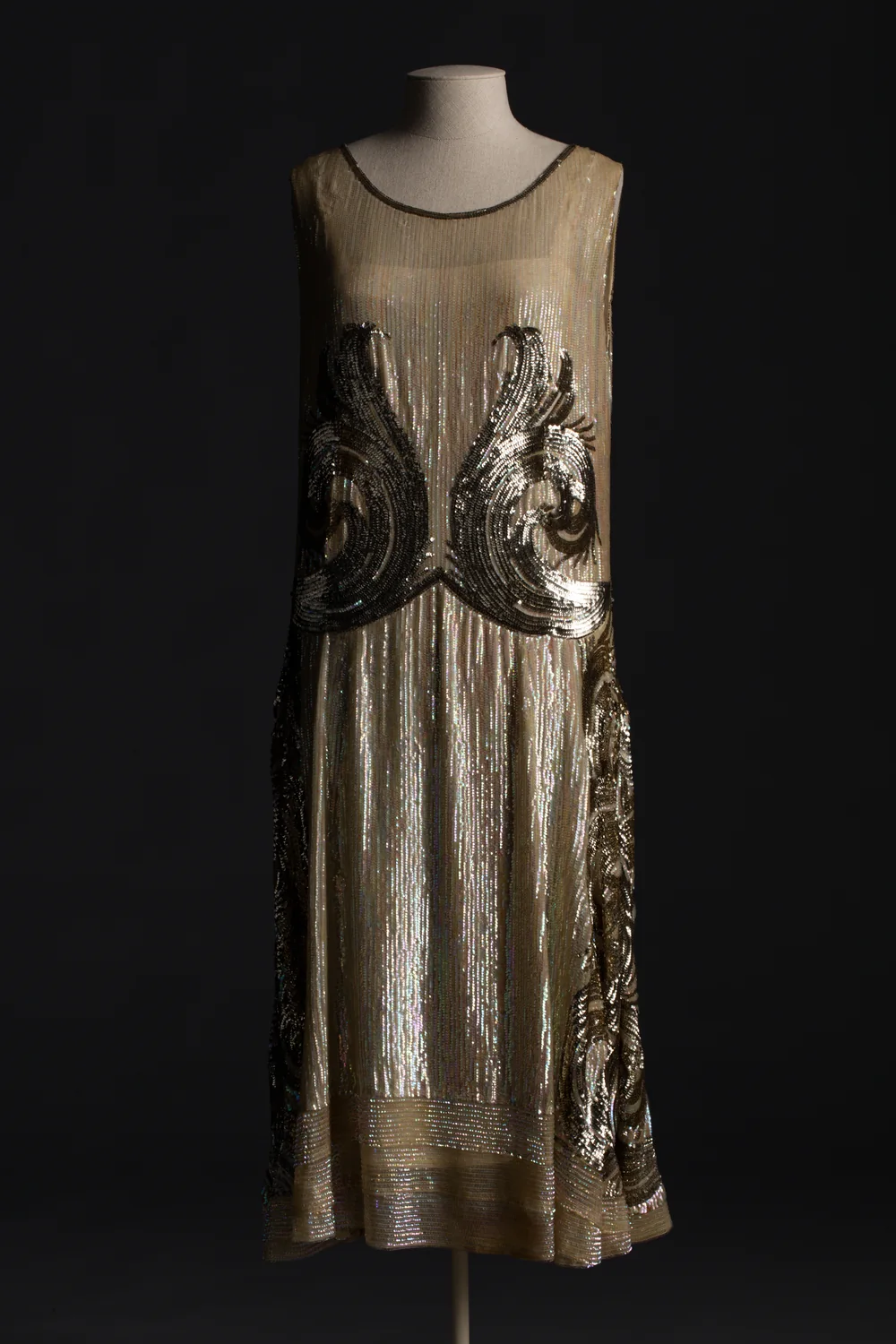
The photograph above shows a sequinned evening dress dated to about 1926 in Auckland Museum. Its low rounded neck, straight body and horizontal change near the hips make the dropped line easy to locate. It is an archival object photograph on a mannequin, not evidence of how one named wearer moved in it.
The waistline is a design line, not a body label
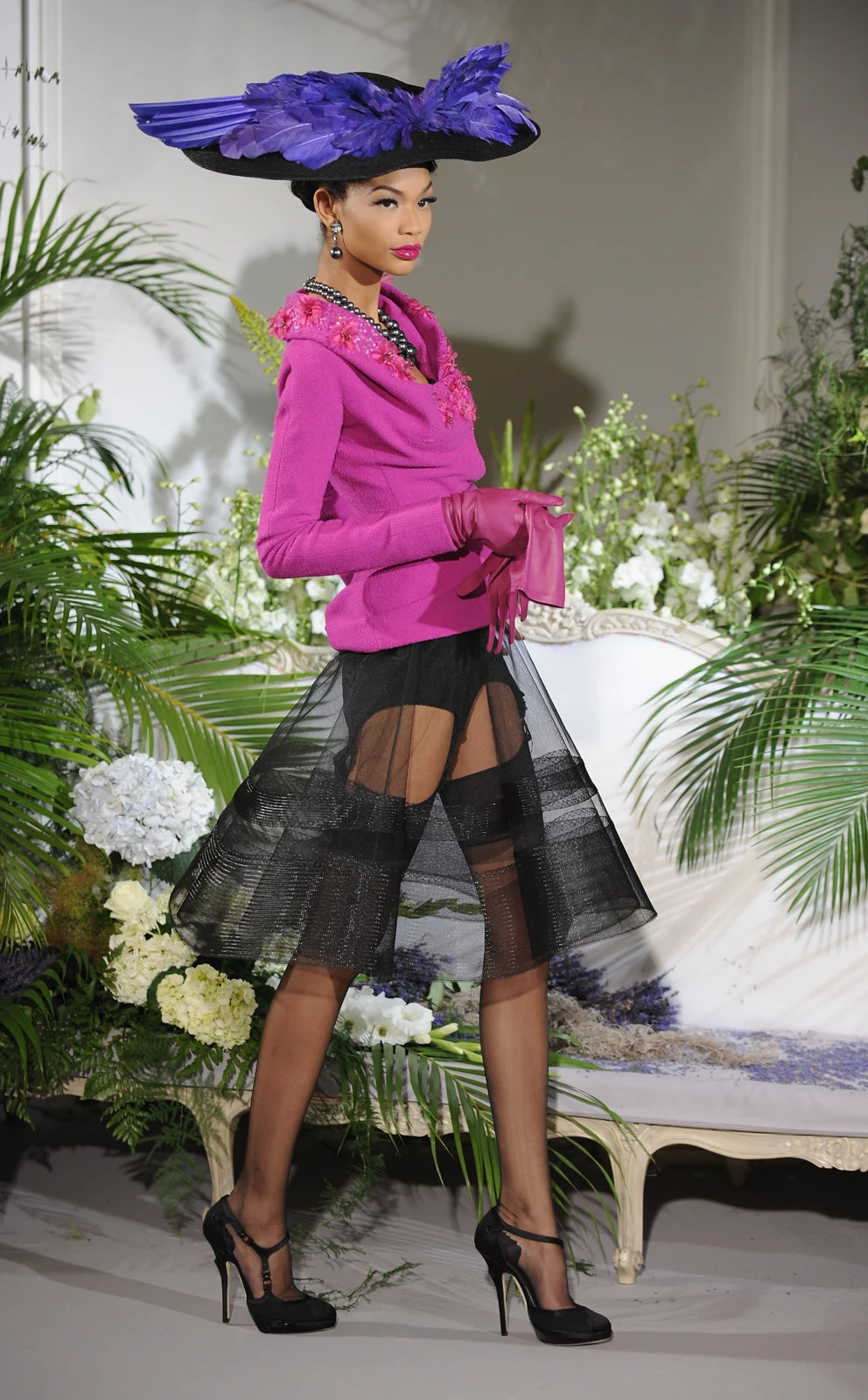
On a natural-waist dress, the main horizontal join or emphasis sits near the narrow area between ribs and hips. Lower that emphasis and the same total dress length is divided differently. More of the garment reads as bodice; the skirt begins later.
The Auckland dress uses more than a seam to establish that division. Its catalogue describes a straight, loosely worn form with a drop waist, while bronze-coloured sequin scrolls run from that area towards the bust. A horizontal panel finishes the hem. Decoration therefore reinforces the cut: vertical light carries the eye down the long upper section, then the lower border closes it.
This is why a dropped waist can be visible even when there is no tightly fitted waistband. Look for the point where fullness is released, where a belt is stitched, where pleats begin or where the decorative pattern changes scale or direction.
Why the line suited the tubular 1920s silhouette
Fashion History Timeline at the Fashion Institute of Technology describes the popular la garçonne look as tubular, with a dropped waist and gradually rising hemlines. The longer upper block reduced the visual interruption at the natural waist. Combined with a straight cut, it could make the dress read as one column from shoulder to hip.
That column did not require every dress to be plain. The Met’s French evening dress of about 1925 uses a scalloped textile pattern, silk and metal while retaining the flattened chest, low waist and raised hem associated with the period. Evening surfaces could be densely beaded or sequinned even when the underlying outline remained simple.
The effect also appeared outside the familiar nightclub image of the flapper. The V&A’s 1926 tennis dress is sleeveless and low-waisted, with a square neck, pleats and green appliqué on white linen. Its geometry shows how a lowered line could organise functional clothing as well as decorated eveningwear.
The waist did not stay at one level for the whole decade
“The 1920s waist” is not one fixed coordinate. Fashion History Timeline reports that fashionable waistlines dropped until about 1923 and began to rise again in 1928; hemlines moved on a different timetable, rising until about 1926 before falling. A dress should therefore be dated from its full construction, materials and provenance—not from one low seam alone.
Nor was the straight dropped-waist dress the decade’s only option. Jeanne Lanvin’s robes de style deliberately revived a fuller, more romantic skirt. The Met’s 1928 La Traviata has a panniered form, taffeta petals on silk tulle and an irregular hem. It belongs to the same decade but resists the idea that every fashionable body had to be a narrow tube.
That counterexample matters. A useful fashion history does not replace one stereotype with another. The dropped waist was influential and recognisable, but designers and wearers still encountered multiple silhouettes, occasions and price levels.
Low placement changes movement as well as proportion
Where a skirt is joined can affect how fullness hangs. Gather fabric at the natural waist and it begins to spread higher on the body. Release it at the hip and the upper section can remain straighter before the skirt moves away. Pleats or panels placed below the hip may swing beneath a comparatively still bodice.
Weight matters too. Sequins, beads and metal thread add mass. A loose dress lets that decorated surface hang from the shoulders rather than being held firmly at a narrow waist. This does not prove that every dropped-waist dress was easier to dance in; lining, armhole size, skirt width, undergarments and embellishment all affect movement. The surviving object can show construction, but comfort requires more evidence than a photograph.
How to identify the dropped line
- Find the natural waist first. On a mannequin, estimate the area between the lower ribs and top of the hips. Do not assume every belt marks it.
- Locate the garment’s break. Trace seams, gathers, pleats, bands and pattern changes. The strongest one may sit several centimetres lower.
- Compare upper and lower lengths. A long shoulder-to-hip block paired with a relatively short skirt creates the characteristic proportion.
- Check front, back and side views. A decorative band may appear low at the front while construction behaves differently around the back.
- Read the catalogue. Date, material, maker and dimensions are stronger evidence than calling any loose sleeveless dress “flapper.”
For more ways to connect seams with the space a garment creates, continue through Runway Note’s fit and fabrics reading route, then compare darts and princess seams.
The line edits the body without tracing it
The dropped waist is best understood as a relocation of emphasis. It lengthens the garment above the hip, postpones the beginning of the skirt and allows decoration or fullness to gather around a lower horizontal point. In many 1920s dresses, that decision supports a straight, simplified silhouette.
Once you learn to find the visual break, the style becomes more precise than “a shapeless flapper dress.” You can see whether the line is made by cut, belt, pleats or beading—and you can also recognise the 1920s gowns that chose an entirely different architecture.
Sources & further looking
Fashion History Timeline — 1920–1929The Metropolitan Museum of Art — Evening dress, ca. 1925Victoria and Albert Museum — Art Deco fashionThe Metropolitan Museum of Art — House of Lanvin, La Traviata, 1928Historical, material and collection references are linked above. Styling exercises and interpretations are our editorial suggestions.
Continue with the style notes guides, or read our editorial policy.