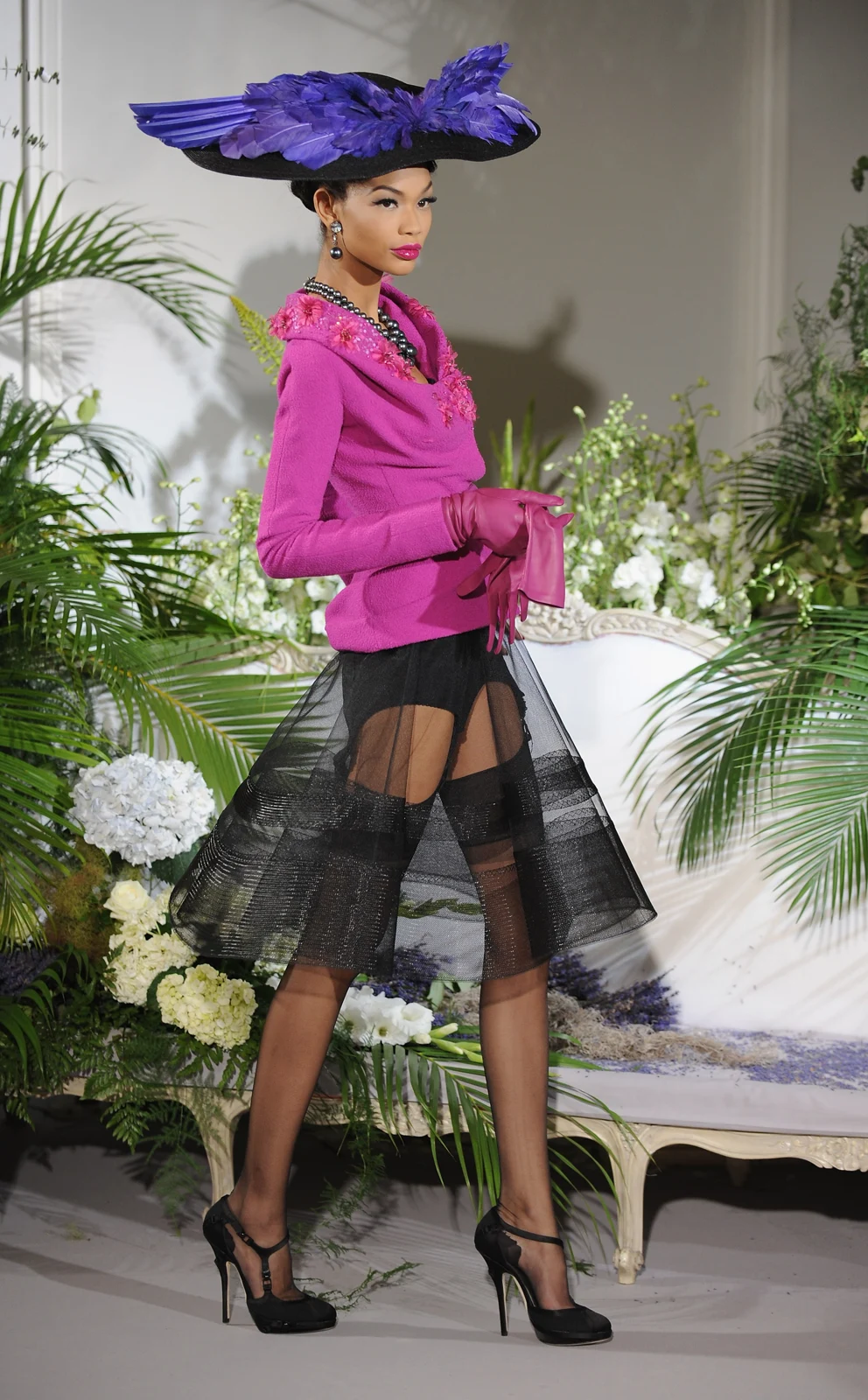
The photograph above shows Chanel Iman at Christian Dior Haute Couture, Autumn/Winter 2009–10, in Paris. It is an archive image from July 2009, not a photograph of Jonathan Anderson’s 2026 Dior collection. Keeping that distinction visible lets us enjoy both moments without confusing them.
Trace the outline before the embellishment
Look first at the outer boundary: the hat, the shoulder, the waist and the skirt. Where does the silhouette move away from the body? Where does it return? At this scale, small decorative details become secondary to the distribution of volume.
Try looking at the image as a small thumbnail. If the shape remains recognisable, the outline is carrying a substantial part of the design. Then enlarge it again and notice which details complicate that first reading.
Notice opaque and transparent areas
Sheerness changes how a shape is perceived. An area can be physically large but visually light because the background remains visible through it. A smaller opaque area can feel heavier by comparison. This is a way of describing the photograph, not identifying a fibre or claiming a particular construction technique.
Separate study from imitation
You do not need a couture gown to explore the relationship between visual weight and actual area. Compare an opaque jacket over a fluid skirt with a lighter layer over a structured lower half. The exercise is about where attention settles.
Photograph each version from a similar distance, with the same lighting and a simple background. Keep the shoes and accessories constant so that the change in outline is easier to evaluate.
A useful archive note
Write a short description that avoids “timeless” or “iconic”: for example, “a narrow opaque centre contrasts with a larger translucent lower shape.” A precise observation can be reused years later. A broad compliment usually cannot.
Couture can be studied as an art of proportion as well as an art of detail. Looking from the outside inward gives both room to speak.
Sources & further looking
Wikimedia Commons — Chanel Iman, Dior Haute Couture 2009, provenance and permissionHistorical, material and collection references are linked above. Styling exercises and interpretations are our editorial suggestions.