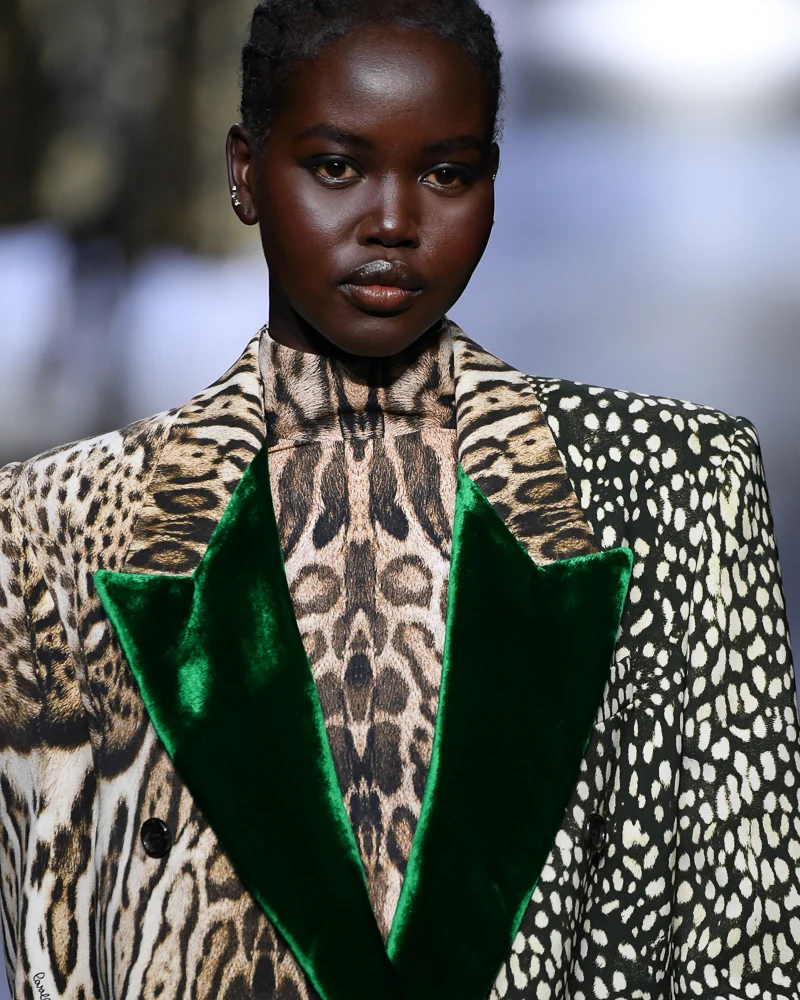
In this archival photograph of Adut Akech on the Roberto Cavalli Fall/Winter 2022 runway, contrasting patterned surfaces meet a green lapel. The photograph offers a compact lesson: a relatively quiet area can give the eye somewhere to rest between busy ones.
This is a reading of one image, not a claim about every look in the collection. The close crop is useful for studying the meeting of surfaces; it cannot tell us everything about the complete silhouette.
Compare the scale before the colours
Put two patterned items side by side. Squint or step back. Does one read as a larger shape while the other becomes an almost continuous texture? That difference can help separate the patterns, even when neither is particularly subdued.
If both prints have equally large, equally contrasty motifs, try introducing a plain piece between them. A waistband, open jacket or scarf can act as a pause. The pause need not be beige or black; it only needs to be less visually busy than its neighbours.
Find a thread of continuity
Look for one repeated colour, similar curve, repeated stripe direction or compatible density. One connection is enough to test. Forcing every colour to match can remove the tension that made the combination interesting.
- Start with the larger patterned piece.
- Add a smaller area of the second pattern.
- Take a photograph from several steps away.
- Remove one accessory and compare the result.
Keep the proportion adjustable
You might dislike a patterned shirt under a patterned jacket but enjoy the same shirt with a patterned scarf. The colours have not changed; their relative area has. Treat area as an adjustable part of the outfit before declaring the pair incompatible.
A photograph does not offer a universal rule for what anyone should wear. It offers a specific arrangement worth examining. Use the archive to make more precise choices, and let comfort and your own taste decide which ones survive the day.
Sources & further looking
Wikimedia Commons — Adut Akech at Roberto Cavalli FW22, source and licenceHistorical, material and collection references are linked above. Styling exercises and interpretations are our editorial suggestions.