Why do fashion shows seem to be a season ahead? Main womenswear Spring/Summer collections are usually presented in September or October of the previous year. Fall/Winter collections are generally presented in February or March of the same year. The show date tells you when the clothes were presented; the collection label tells you the season they are designed to represent. Neither date alone tells you when a particular item will be available to buy.
For example, Spring/Summer 2027 womenswear appeared on the runway in September and October 2026. That is why an article published in 2026 can accurately discuss a 2027 collection. In casual conversation this is sometimes called “a year ahead,” although the gap between a September show and the following spring is closer to several months than a full year.
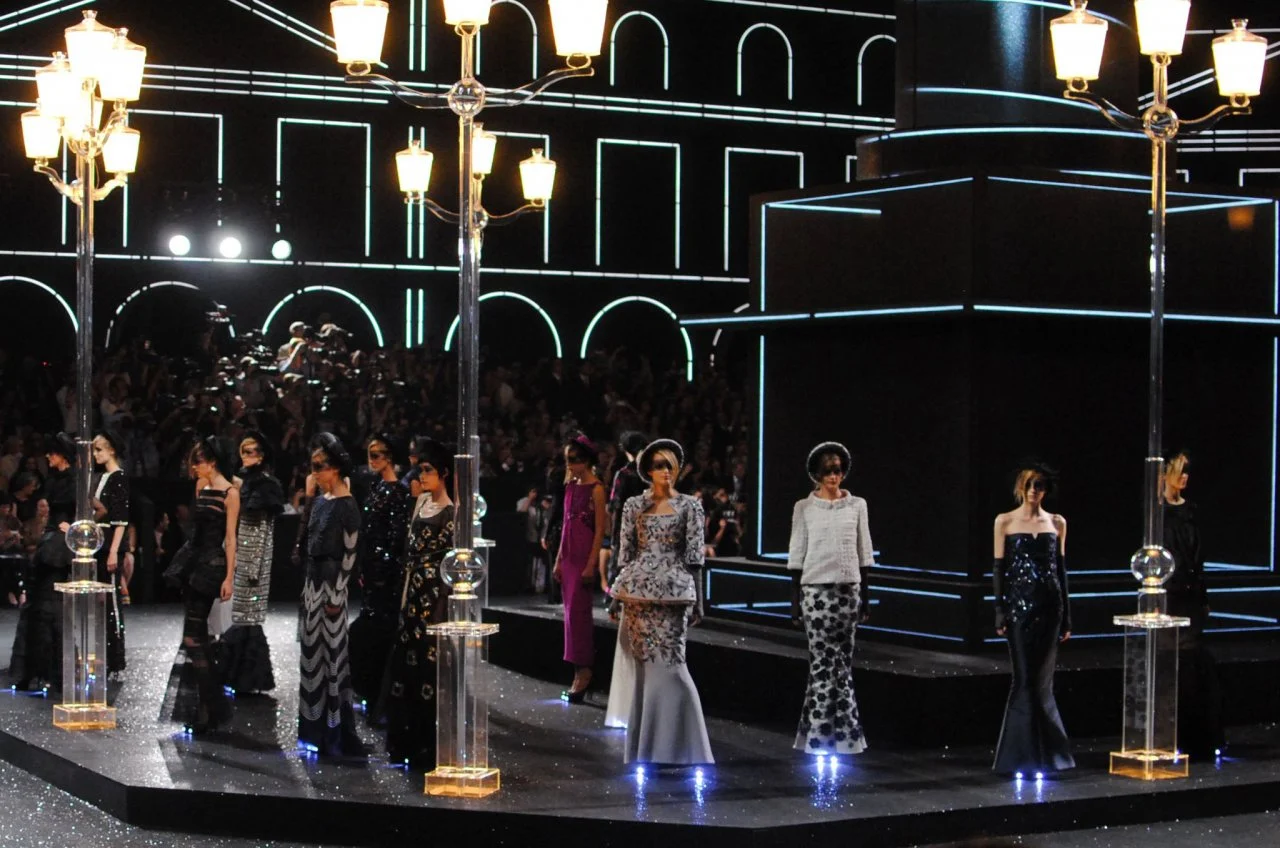
The photograph above is an explicitly dated Autumn/Winter 2018 archive image. It is included to demonstrate why a collection’s season belongs with its photograph; it does not depict a 2026 or 2027 collection.
When are the main fashion seasons shown?
The Fédération de la Haute Couture et de la Mode lists Paris womenswear Spring/Summer in September and Fall/Winter in March. New York and Milan may use slightly different dates; the house or city calendar is the best source for a particular show. Prada’s archive provides a concrete example: its Spring/Summer 2027 womenswear appeared in September 2026, while its Fall/Winter 2026 womenswear appeared in February 2026.
| Collection label | Typical womenswear show period | Season named by the label |
|---|---|---|
| Spring/Summer 2027 (SS27) | September–October 2026 | Spring and summer 2027 |
| Fall/Winter 2026 or 2026/27 (FW26) | February–March 2026 | Autumn and winter 2026/27 |
These are main womenswear runway patterns, not a timetable for every brand or garment. Menswear, haute couture and interseason collections have their own calendars. The official calendar also distinguishes a show from a presentation; both may belong to the same season.
| Label | What it tells you |
|---|---|
| AW26 or FW26 | Autumn/Winter 2026 |
| SS27 | Spring/Summer 2027 |
| Shown September 2026 | When the presentation happened |
| Published 2 October 2026 | When this article was published |
What does “the current fashion season” mean?
Ask whether the writer means the clothes people are wearing and buying now, or the latest collection being shown to press and buyers. In autumn, the latest major womenswear runway coverage may already be about the following Spring/Summer even while shops display Fall/Winter clothing. A show title is therefore a forecast label, not a description of today’s weather or what is on every shop rail.
For a specific look, record three separate facts: the collection season printed by the house, the show date on an official calendar, and the image date or source. If one is unknown, leave it unknown. This is especially useful when an older runway image circulates again as inspiration.
Why it matters for trend coverage
A story about what is being shown now is not automatically a story about what is arriving in shops now. Combining the two without explanation makes trend reports feel contradictory. The useful question is whether an article is examining a current wearing season or looking ahead.
Read the label before the headline
On this site, collection-specific articles display their season. “Seasonless” marks a practical guide; “Editorial palette” marks a proposed colour combination rather than a claim about one runway. “SS26 Couture” identifies couture coverage separately from ready-to-wear.
A practical example: three labels on one photograph
Imagine saving a photograph from Prada's Spring/Summer 2027 womenswear show. You may encounter three dates: September 2026, when the show appears in Prada's archive; Spring/Summer 2027, the collection designation; and the date on which a publication wrote about the photograph. Each is true for a different purpose. Put all three into your image note if you intend to revisit it later.
The collection season is not the date the photograph was taken. A photograph can also be republished years later with a new article date. This matters on social platforms, where the original caption often disappears and an archival look may be described as a new trend.
Decode common abbreviations
| You see | Read it as | Do not assume |
|---|---|---|
| SS27 or S/S 2027 | Spring/Summer 2027 collection | That the show took place in 2027. |
| AW26 or FW26 | Autumn/Fall–Winter 2026 collection | That every piece was sold in the same month. |
| HC SS26 | Spring/Summer 2026 haute couture | That it follows a ready-to-wear delivery schedule. |
| Resort or Cruise | An interseason collection label | That its timing matches a city's main fashion week. |
Check a claim in under a minute
- Open the fashion house's own show archive or a fashion-week schedule.
- Record the event month and collection title exactly as displayed.
- Open the image source and check whether the pictured garment belongs to that collection.
- Only then describe the look as current, archival or forthcoming.
If a source has no date, say the timing is unclear rather than guessing from the style of the clothes. Publication and shopping are separate questions: the show archive tells you what was presented, while a current product page may tell you what can actually be ordered. That distinction makes future-looking trend coverage far less confusing.
The photograph on this page is a 2018 archive image. It illustrates why the original season belongs in a caption even when the surrounding article is about 2026 and 2027.
Collections and retail delivery schedules are not interchangeable, so a show date alone does not confirm when a particular piece can be bought. Use the house’s own product information for availability. Our catalogue is designed for reading and looking, not as a stock checker.
Sources & further looking
Prada — official fashion-show archiveFédération de la Haute Couture et de la Mode — Paris Fashion Week calendar and seasonal scheduleCFDA — September 2026 New York Fashion Week schedule for Spring/Summer 2027Historical, material and collection references are linked above. Styling exercises and interpretations are our editorial suggestions.
Continue with the runway guides, or read our editorial policy.