The familiar complaint that women’s clothes have no useful pockets can make the past sound simple: men had pockets, women had handbags. A surviving accessory from about 1784 shows why that neat division does not work. It is a pocket, but not one sewn permanently into a dress. It was a separate textile object, tied around the waist and worn beneath other layers.
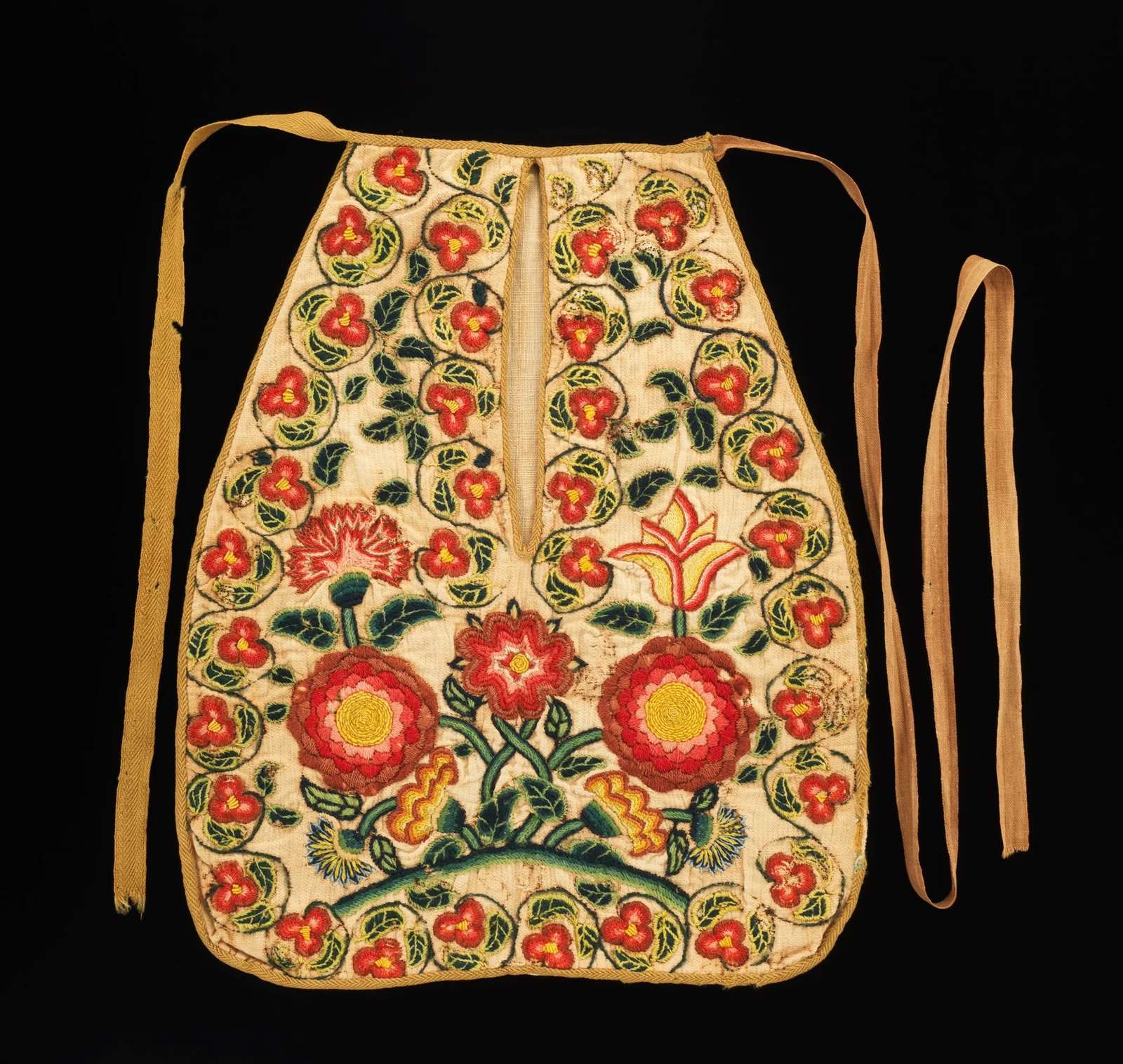
The embroidered pocket pictured above belongs to The Metropolitan Museum of Art. It is an American example made from cotton and wool, densely covered with red, blue, pink and green floral motifs. The photograph shows the object laid flat, not how it looked under a skirt. To understand its use, the opening and the tie matter as much as the decoration.
What was a tie-on pocket?
The V&A describes women’s tie-on pockets as detachable accessories that became widely used during the 17th century. They were commonly pear-shaped, with a vertical slit, and could be worn singly or in pairs. A tape around the waist held them independently of the gown or petticoat. Openings in the outer garments allowed the wearer to reach through to the pocket beneath.
This arrangement meant that one pocket could move between outfits. It could be removed at the end of the day, placed in a drawer or hung nearby without emptying every item into a different garment. It also explains why a museum may catalogue the pocket separately from any surviving dress: the two were related in use but were not one permanent object.
Not a tiny decorative purse
Many surviving tie-on pockets are surprisingly large. The V&A notes examples around 40 centimetres long and 30 centimetres wide, although size varied. Women used them for practical and personal possessions such as keys, coins, handkerchiefs, spectacles, sewing tools and papers. Contents differed by work, household responsibilities, travel and social setting.
The important distinction is between a pocket and a bag held in the hand. A tie-on pocket could sit close to the body while leaving both hands free. When worn beneath petticoats, it could also keep possessions out of sight. For working women, the same type of pocket might be positioned more visibly under an apron for quicker access. Fashion history becomes more precise when it asks how an object was reached, not only whether it was visible.
How to read the Met pocket
Start with the long central slit. Its dark outline creates the entrance while dividing the embroidered surface without cutting the floral design into two unrelated halves. Then look at the upper edge, where the pocket would meet its fastening. The broad lower area provides the storage space; the narrowing top helps locate that volume at the waist.
The Met dates the object to about 1784 and identifies roses, tulips and carnations in its design. Its catalogue suggests that an untrained embroiderer may have worked the motifs freehand at home, while noting similarities to Pennsylvania samplers and English crewelwork. That is the museum’s interpretation of this particular pocket, not a claim that every tie-on pocket was homemade or decorated in the same way.
Decoration could make an everyday object personally significant, even if it normally remained hidden. At the same time, plain pockets made from durable or reused fabric also existed. The category covered utility and ornament rather than belonging to a single class or aesthetic.
Handbags did not simply replace them overnight
It is tempting to tell the story as a straight line: tie-on pockets disappear, handbags arrive. The V&A cautions against that sequence. Bags, integrated pockets and detachable pockets could coexist because they served different purposes. The museum points to the late-17th-century Lady Clapham doll, whose wardrobe includes a tie-on pocket, a petticoat with integrated pockets and a drawstring gaming bag.
Changing silhouettes eventually made bulky hidden pockets less practical, but that does not turn the handbag into a single instant replacement. Shape, access and the number of garments worn over the pocket all affected whether the system worked. Continue through Runway Note’s fit and fabrics reading route to see how construction changes the way clothes function.
A better pocket test for clothes now
The tie-on pocket offers a useful method for judging modern clothing without pretending that an 18th-century accessory is a ready-made solution for today. Put on the garment and ask four concrete questions: can your hand enter the opening naturally; does the pocket hold a phone or keys without pulling the silhouette out of shape; can you sit comfortably with the item inside; and does a shoulder bag press against the same area?
Placement is part of fit. A generous pocket can still be awkward if the opening sits too far back, the lining twists or the contents strike the hip while walking. Conversely, a visually small opening may lead to a deeper internal space. Test the real garment instead of judging from the outline alone.
The larger historical lesson is not that women once had a perfect pocket system. It is that storage has always been a design problem involving body, clothing layers, movement and privacy. The embroidered object in the museum is beautiful, but its beauty is only half the story. The slit, waist tie and hidden volume explain what it was built to do.
Sources & further looking
The Metropolitan Museum of Art — Pocket, American, ca. 1784V&A — Women’s tie-on pocketsHistorical, material and collection references are linked above. Styling exercises and interpretations are our editorial suggestions.
Continue with the style notes guides, or read our editorial policy.