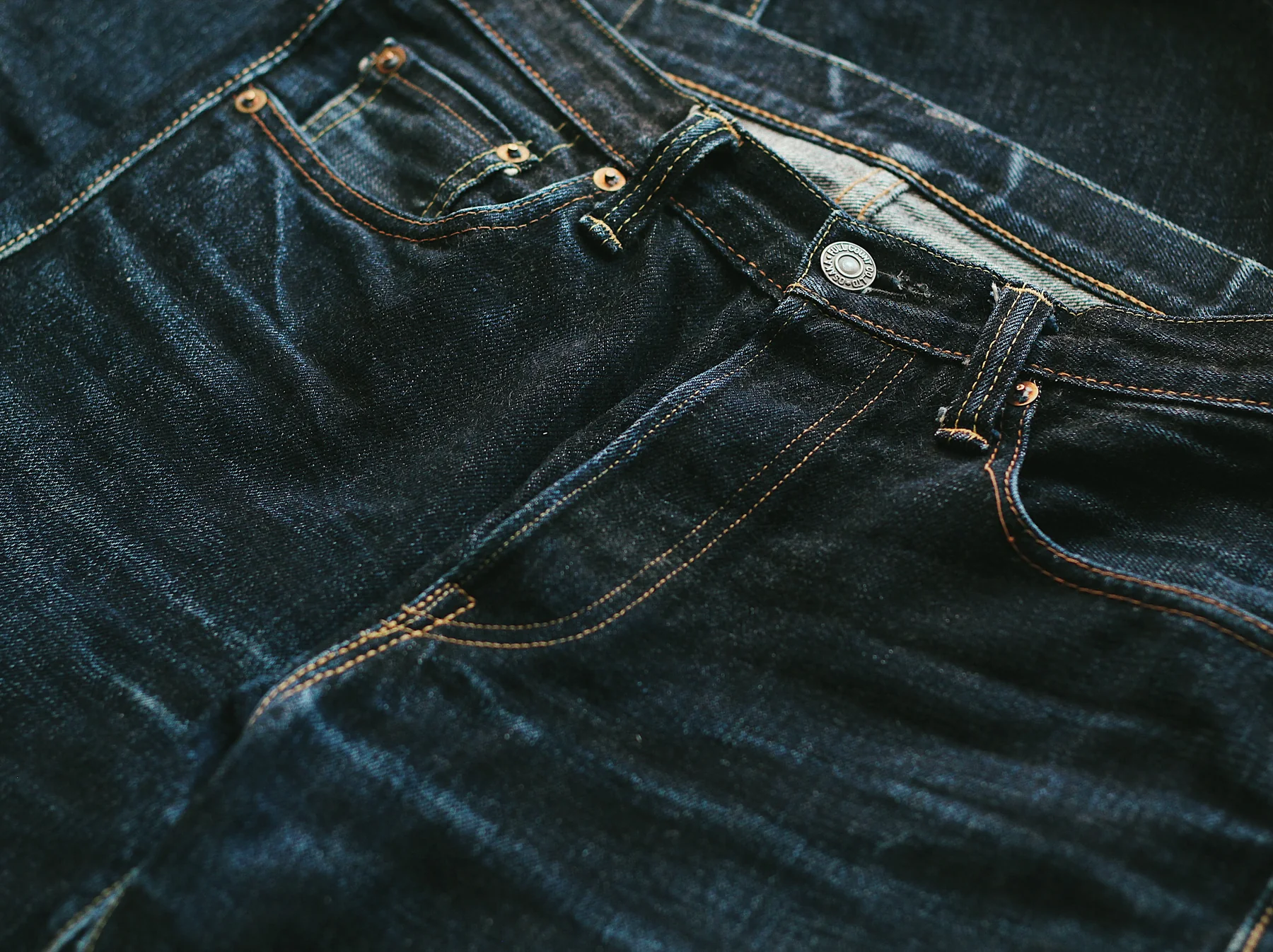
Well-worn jeans rarely fade into one flat, paler blue. Light lines spread from the front of the hips, parallel bands form behind the knees, and raised seams become brighter than the cloth beside them. Denim enthusiasts call the first pattern “whiskers” and the second “honeycombs.” The names are visual shorthand, but the reason for the contrast begins inside the yarn.
The photograph above shows naturally developed fading on a pair of Japanese selvedge jeans identified by the photographer as Full Count denim. It is an illustrative wear example, not proof that every jean, fit or wash will produce the same pattern.
Denim starts with two directions of yarn
Most classic blue denim is a cotton twill woven with indigo-dyed warp yarns running lengthwise and undyed filling, or weft, yarns crossing them. CottonWorks explains that the warp passes over and under the filling in a repeated twill sequence. This creates the diagonal ribs visible on the face and helps explain why the front and back of denim do not look identical.
The blue face therefore is not simply a solid sheet of colour. It is a structure in which dyed yarns dominate one surface while lighter yarns remain part of the weave. As abrasion removes fibre from high points, both yarn colour and weave become easier to see.
Indigo sits differently from many other dyes
CottonWorks describes indigo as unusual among major textile dyes because it concentrates in the outer layers of the cotton yarn during the denim dyeing process. The result is often called ring dyeing: an intense blue ring surrounds a lighter or white yarn core.
That arrangement is central to denim’s ageing. When the outer blue layers abrade, the lighter core becomes visible. A thick section of yarn may be rubbed far enough to expose white while a neighbouring lower section retains more blue. Low-twist yarns can also wash down or abrade faster than more tightly twisted yarns. Yarn thickness, twist and evenness therefore affect the final pattern as well as the dye.
This does not mean that every denim has a perfectly white centre. Dyeing methods, sulphur bottoming or topping, fibre blends, stretch yarns, finishing and overdyeing can alter the cross-section and final colour. “Indigo denim” names a broad family, not one guaranteed recipe.
Why creases turn into pale lines
Cloth repeatedly folds at the places where the body bends. At the front hip, sitting creates radiating creases. Behind the knee, bending compresses the fabric into stacked angles. The tops of those folds meet more friction than the valleys around them, so their blue outer fibres wear sooner.
Once the body repeats a crease in roughly the same place, abrasion repeats too. The fade grows as a line rather than an even cloud. Fit changes the map because it changes where cloth has excess volume, where it is held taut and where it folds. Movement, occupation, pocket contents and carrying habits add further variation.
High contrast is not automatically evidence of a better jean. It can reflect a dark starting shade, a ring-dyed yarn, limited overall colour loss and concentrated local abrasion. It can also be produced deliberately before purchase.
Natural wear and factory finishing can resemble each other
CottonWorks notes that whiskers and crease effects are widely created during garment finishing to imitate lines developed through repeated wear. Dry sanding, resin-set creases, lasers, washing, enzymes and other processes can remove or discharge colour in selected areas.
That means visible whiskers on a new pair are not a record of another person’s body. They may be a designed finish. Conversely, a dark unwashed jean does not promise dramatic future contrast: dye penetration, yarn construction, fit and care all influence the result.
The Museum at FIT’s Denim: Fashion’s Frontier exhibition places this technical flexibility in a longer fashion story. Denim moved from 19th-century workwear into leisure, designer jeans and runway clothing, while treatments such as stone-washing and acid-washing turned wear itself into a marketable appearance. Fading is now both a consequence of use and a design language.
Washing changes the whole field
Local rubbing and laundering are related but not identical. Creases concentrate abrasion in particular zones; washing exposes the whole garment to water, detergent and mechanical movement. More aggressive processing can reduce the overall indigo level, lowering the contrast between worn lines and their background.
There is no responsible universal instruction to “never wash” jeans. Sweat, soil and grit can remain in the fabric, and care needs vary with fibre blend, finish and use. Follow the garment label. When it permits, washing inside out, closing fasteners, using an appropriate gentle cycle and avoiding unnecessary high heat can reduce avoidable surface abrasion. Wash with similarly dark items because loose indigo may transfer.
If preserving a dark shade matters more than developing contrast, reduce needless friction and wash only when the garment needs it—not according to a rigid internet schedule. If you prefer an even, softened blue, regular label-compliant laundering will usually move the garment in that direction. Neither choice proves greater authenticity.
How to read a faded pair of jeans
- Trace the twill. Look for the diagonal ribs and compare the blue face with the inside, where lighter filling yarns are often more obvious.
- Find repeated folds. Match pale lines to the hips, knees, pocket edges, hem and seat. A fade map usually follows movement and contact.
- Separate wear from finishing. Perfectly symmetrical lines present at purchase may be designed. Irregular changes that deepen with your movements are more likely to record wear.
- Inspect the fibre, not only the colour. A pale area can be sound, or it can be thinning. If threads are breaking, the issue has moved from patina to repair.
For more ways to connect weave, yarn and wear, continue through Runway Note’s fit and fabrics reading route. To work a changing indigo shade into an outfit, the colour combinations route offers proportion-based exercises.
Fading is colour shaped by use
Indigo denim’s characteristic ageing comes from several layers of design working together: blue concentrated near the yarn surface, lighter material beneath it, a twill weave with raised points, and a garment that repeatedly bends around a moving body.
The resulting whiskers and honeycombs are not random damage, but they are not a universal quality certificate either. They are a record of where colour, construction and friction met. Read that record carefully and a faded jean becomes more than “old blue”: it becomes a map of material behaviour.
Sources & further looking
CottonWorks — Denim basicsCottonWorks — Denim construction and indigo ring dyeingCottonWorks — Denim finishingMuseum at FIT — Denim: Fashion’s FrontierHistorical, material and collection references are linked above. Styling exercises and interpretations are our editorial suggestions.
Continue with the colour guides, or read our editorial policy.