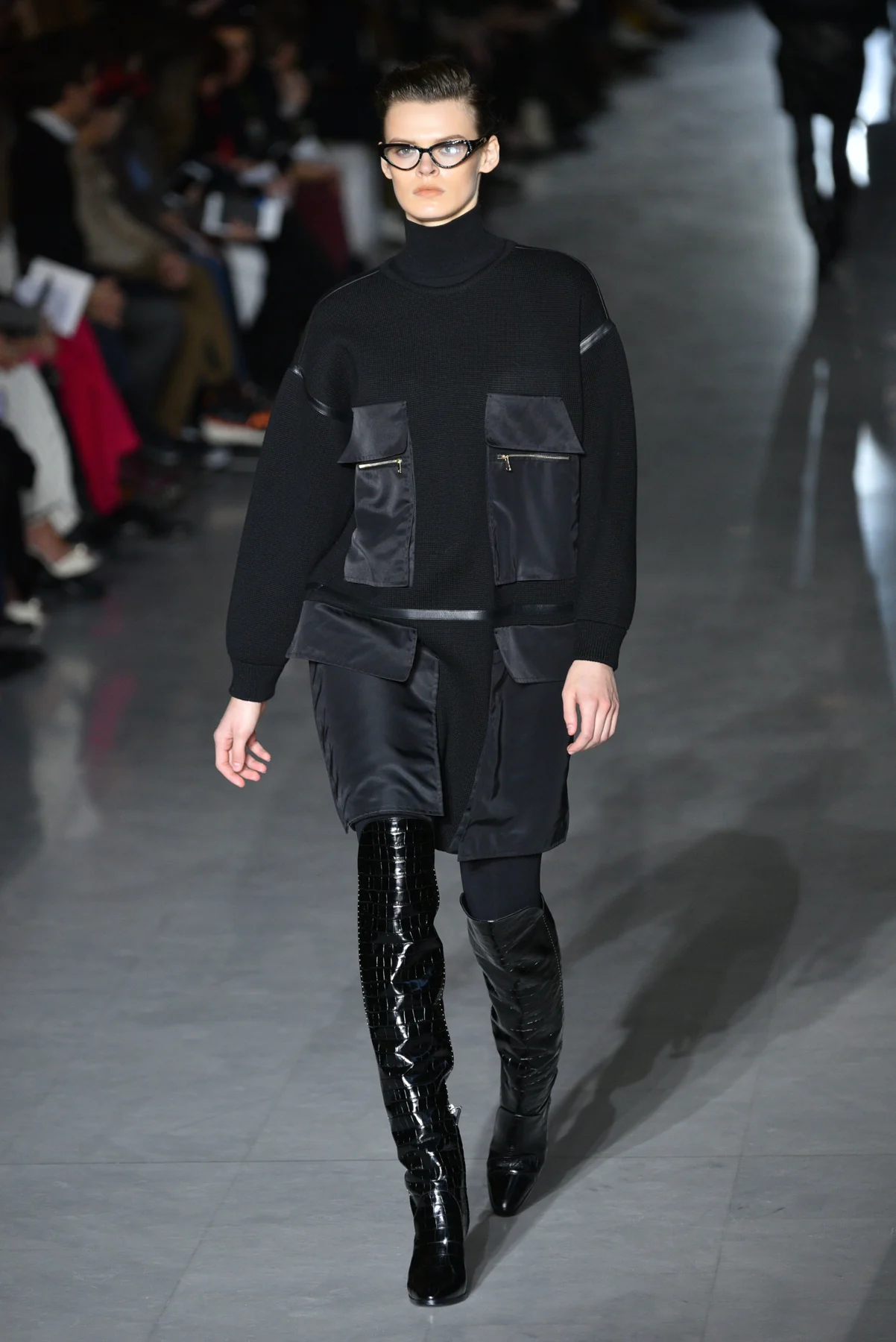
A trench coat can look almost over-equipped: shoulder tabs, sleeve straps, overlapping front panels, a belt, metal rings and an extra layer across the back. On many modern coats those elements work mainly as visual signatures. Their arrangement, however, began as a practical system for weather, equipment and military dress rather than a collection of arbitrary decorations.
The photograph above is a modern illustration of the general silhouette. It is not a First World War document, and the source does not identify the coat as Burberry. The historic details below come from museum records, not from an attempt to date or authenticate the garment in the photograph.
The fabric came before the familiar outline
The V&A’s guide to its Burberry trench display traces the design to Thomas Burberry’s development of weatherproof gabardine in 1879 and its patent in 1888. The museum describes a tight twill structure made from specially prepared yarn. Early versions used linen; later examples used other fibres, with classic Burberry gabardine made from fine cotton. Its combination of water resistance and breathability distinguished it from conventional rubberised waterproof cloth.
This matters because a raincoat does not become useful through flaps alone. The cloth has to slow water while remaining wearable. Twill also gives the surface a diagonal structure, although a photograph cannot confirm a particular weave or finish. Read a composition label and maker’s information before calling every beige, belted coat gabardine.
From the Tielocken to the Trench-Warm
The V&A identifies Burberry’s Tielocken, patented in 1912, as a predecessor of the trench coat. Its name referred to a secure tie-and-lock fastening. During the First World War, the Burberry Trench-Warm added a removable fleece liner and details adapted to officers’ needs. That history helps explain why the coat still looks modular: layers could be added, tightened or used to carry something.
Military origins should not be turned into a claim that one company invented every raincoat feature in isolation. Other makers produced weatherproof outerwear, and trench-like shapes continued to change. A useful way to read the design is to ask what each feature controlled: identification, equipment, rain, airflow or the volume of the garment.
What the straps and flaps were for
- Epaulettes: the V&A notes that shoulder tabs could display insignia or hold gloves. On a modern fashion coat they may retain the outline without serving either task.
- D-rings: rings on the belt offered places from which equipment could hang. They were not originally handbag hooks, even if a contemporary wearer gives them another use.
- Gun flap: the museum lists this front overlay among the Trench-Warm’s additions. It is distinct from the back storm shield, despite the two features sometimes being grouped together in casual product descriptions.
- Storm shield: the extra back layer contributes another barrier in wet conditions while allowing the coat’s upper back to move as a separate plane.
- Adjustable cuff straps: tightening the sleeve opening added protection in rain. Today the strap also changes the sleeve’s shape and the amount of fabric gathered at the wrist.
The belt completes the system by controlling volume at the waist. Worn open, the coat hangs as a broad outer layer; tied firmly, it gathers the body of the coat and makes the skirt below the belt more visible. That change of proportion is one reason the trench moved easily from uniform-derived outerwear into fashion.
Reducing seams was another route to weather protection
A London Museum record provides a useful comparison. Its women’s worsted-gabardine mackintosh, sold by Swan & Edgar around 1918–1920, has a shawl collar and dolman sleeves rather than the complete set of details now associated with the classic trench. The museum notes that most of the coat is cut from one piece of fabric to reduce seams and make it more waterproof.
That object shows that functional rainwear did not follow one fixed recipe. One coat could add shields and adjustable parts; another could reduce the number of places where water might enter. Silhouette and construction were being negotiated together. The trench coat is best understood as one influential answer, not the only possible answer.
How to inspect a modern trench coat
Begin with the parts that actually move. Tighten and loosen the cuff straps. Does the sleeve remain comfortable over knitwear? Lift your arms with the belt fastened. Does the back shield allow movement, or does the coat pull across the shoulders? Sit down with the coat closed and check whether the double-breasted overlap becomes bulky.
Then turn the coat inside out. A removable liner, taped or carefully finished seams, a back vent and secure pocket bags affect use more than a decorative ring. If the label names gabardine, look for the diagonal twill and confirm the fibre content separately. Continue through Runway Note’s fit and fabrics reading route for more ways to connect material, construction and movement.
Finally, decide whether you want the belt to define the waist or simply hang as part of the coat’s architecture. Try three versions: closed and tied, closed with the belt knotted behind, and fully open. Keep the rest of the outfit unchanged. The experiment reveals how much of the trench’s character comes from hardware and how much comes from the adjustable silhouette.
A design language that outlived its first job
The modern trench does not need to carry military equipment to make sense. Its details survive because they divide a large expanse of cloth into readable zones: shoulder, chest, waist, cuff and back. Some remain functional, some have become symbolic, and some do both depending on the garment.
That is the most useful way to look at all those straps and flaps. Do not assume that every detail on every coat performs its historical task. Check what is stitched, adjustable or removable. The closer you look, the easier it becomes to separate a functioning piece of outerwear from a coat that borrows only the trench’s visual vocabulary.
Sources & further looking
V&A — The Burberry Trench: Crafting an Icon, large-print guideLondon Museum — Women’s gabardine trench coat, 1918–1920Historical, material and collection references are linked above. Styling exercises and interpretations are our editorial suggestions.
Continue with the style notes guides, or read our editorial policy.