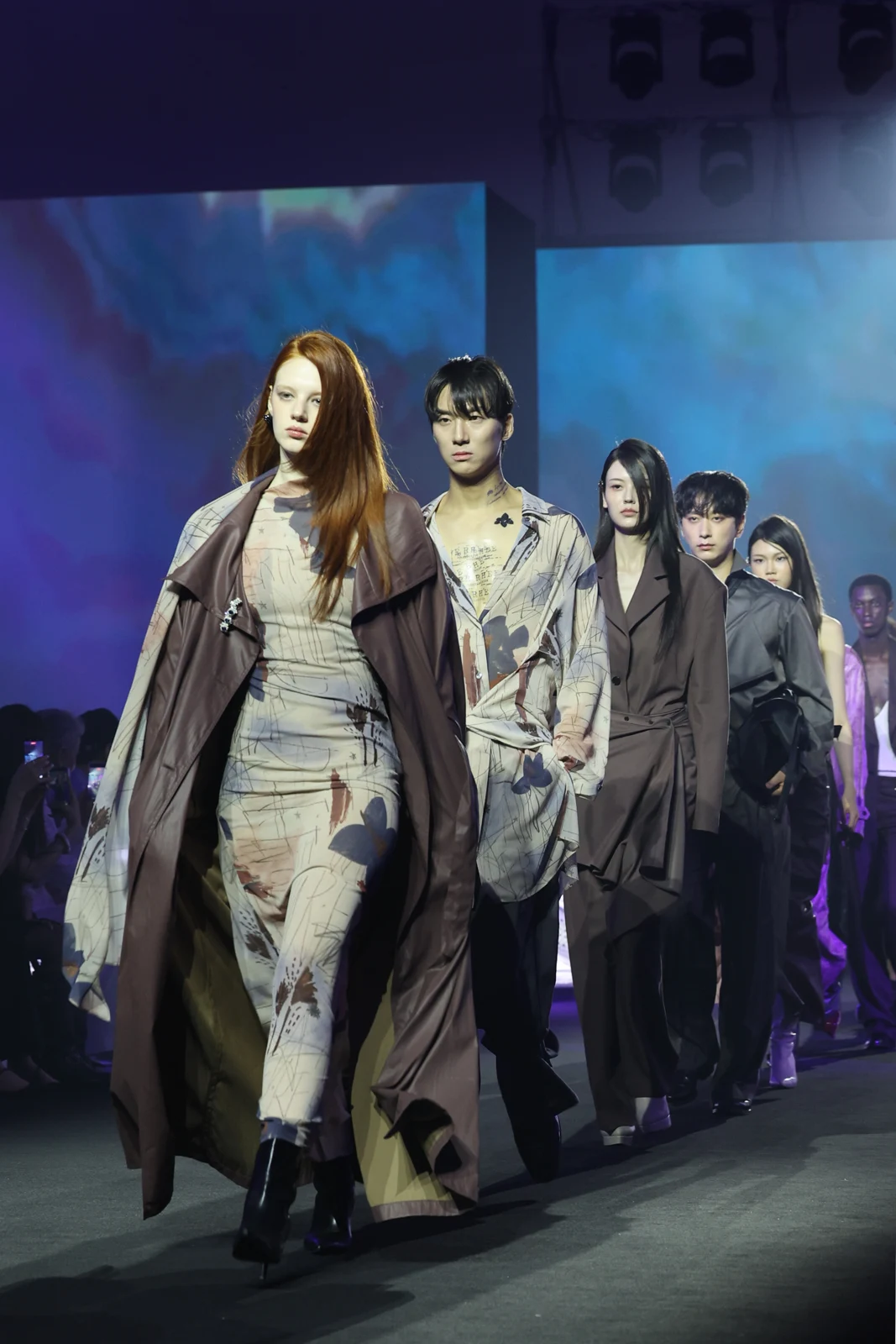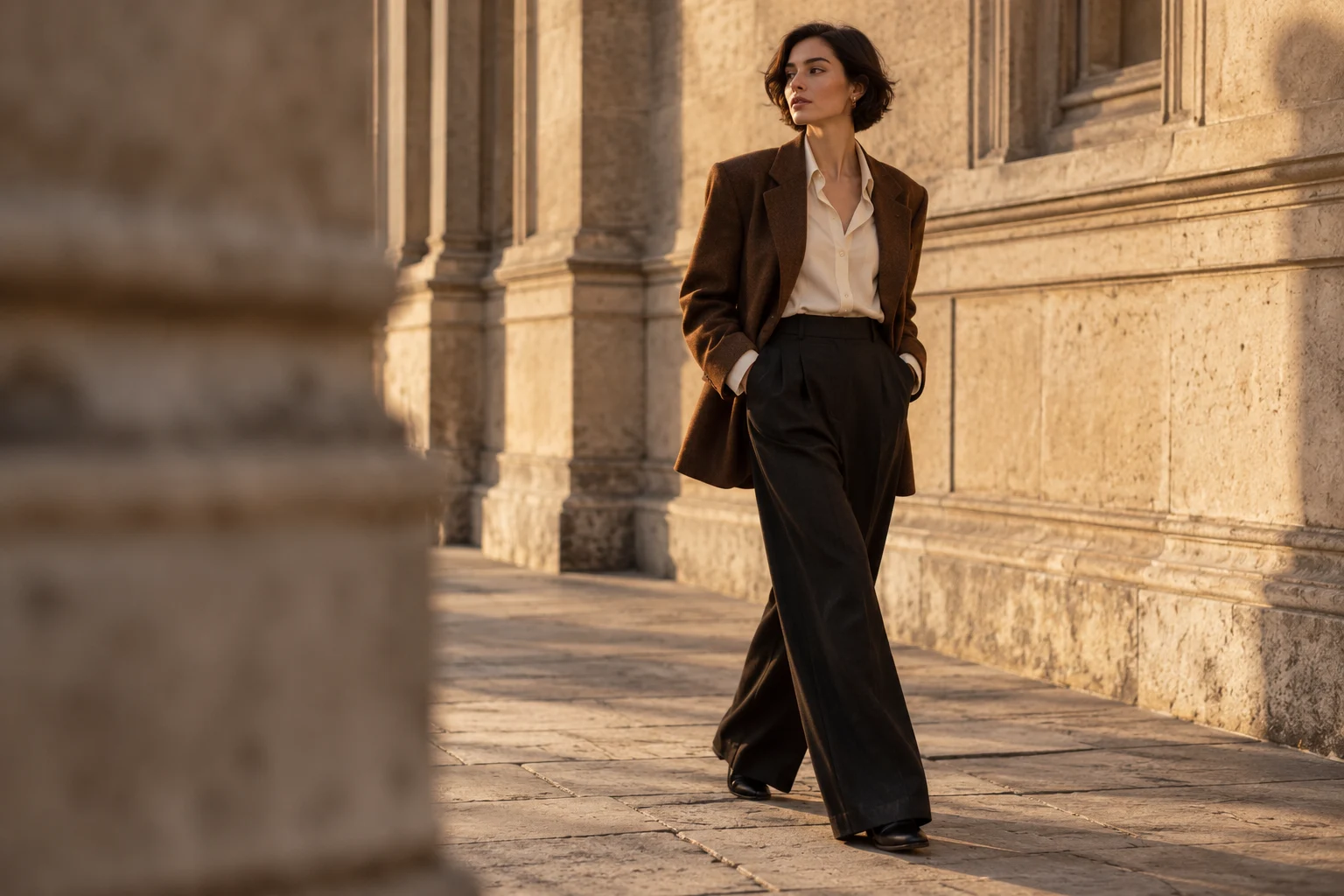
The most useful question after a fashion show is rarely “What do I need to buy?” Try “What has changed about the way these clothes are put together?” A familiar skirt can become unfamiliar through its placement. A practical coat can interrupt an evening outfit. Colour can do the work that a new silhouette usually does.
This is a selective reading of 2026, not a ranking of every collection or a claim about what everyone is wearing. Autumn/Winter 2026 is the season to wear now; the Spring/Summer 2027 collections being shown in 2026 belong to a different chapter. We keep those labels visible throughout this edition.
01 / Think in layers, not complete outfits
Prada’s Autumn/Winter 2026 notes explicitly make layering and transformation central to the collection. Our takeaway is a styling question: can each layer change the reading of the one beneath it?
Try a shirt, a fine knit and a coat you already own. First wear them with only a narrow strip of shirt visible. Then open the knit and expose more of the shirt. Finally remove the middle layer. Photograph the three versions from the same distance. The experiment is about the edges, lengths and areas of colour that become visible, not how many garments you can fit on your body.
02 / Let colour interrupt the neutral
The season’s colour conversation includes cobalt, purple and burgundy in Vogue’s Fall 2026 survey. That does not mean the neutral wardrobe has expired. It means a neutral can act as the background that makes a stronger shade legible.
A grey outfit with a purple scarf and a purple outfit with grey shoes use the same pair of colours but have entirely different energy. Before rejecting a combination, reverse which colour occupies the most space. A small red bag beside a large blue coat is easier to read than two equally large blocks competing for attention.
03 / Look closely at the surface
Loewe’s Fall/Winter 2026 material notes describe leather fringe and embroidery, sculpted shearling and injection-moulded boots. Those techniques invite a closer look at how a surface has been made.
For an everyday interpretation, compare smooth, fuzzy and reflective pieces already in your wardrobe. A matte trouser and a lustrous shirt create contrast without requiring a complicated print. In a photograph, flatten the image into a small thumbnail: if the outfit still has depth, the surfaces are doing useful work.
04 / Borrow a relationship
You do not need the identical runway garment to learn from a collection. Borrow the relationship between a long and a short layer, a soft fabric and a rigid edge, or a bright colour and a subdued one. Keep the part that fits your day and leave the rest as fashion to enjoy.
A three-look experiment
- The baseline: wear a familiar outfit exactly as usual.
- The runway question: change one proportion, one surface or one colour pairing.
- The personal version: adjust that change until you can walk, sit and spend your real day in it.
Keep the photographs that teach you something, including the unsuccessful version. An outfit can be visually interesting without becoming your uniform. The point of watching fashion is to expand your vocabulary, not replace your wardrobe every season.
Sources & further looking
Prada — Fall/Winter 2026 collection notesLoewe — Fall/Winter 2026 show and craft detailsVogue — Fall 2026 colour reportHistorical, material and collection references are linked above. Styling exercises and interpretations are our editorial suggestions.