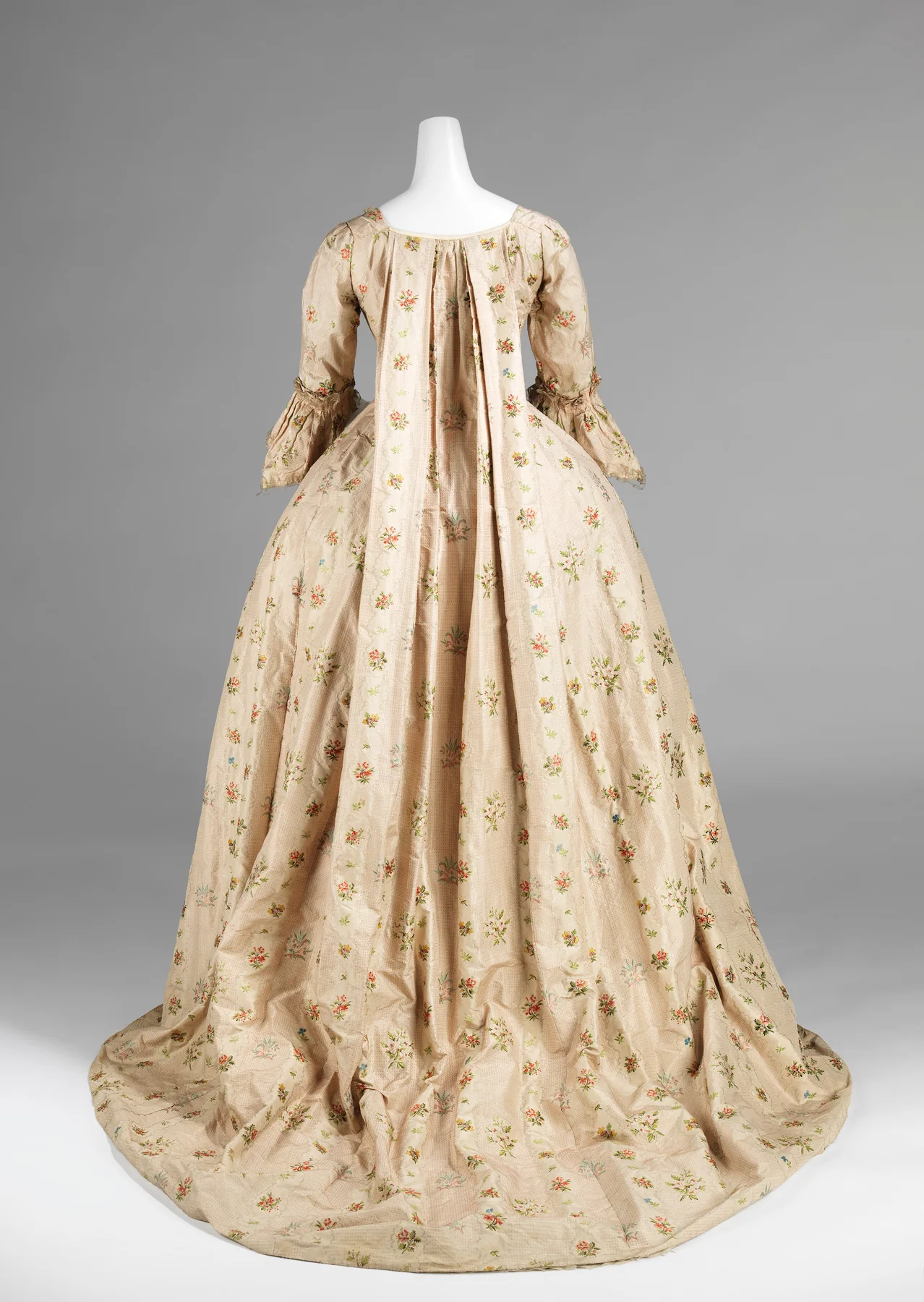
Viewed from behind, the robe à la française in the photograph seems to divide into two different garments. Its upper back follows the torso, while a pair of deep folds begins at the neckline and releases a long curtain of striped silk towards the floor. That transition is not incidental fullness. It is the feature that makes the back immediately legible as a robe à la française.
The Metropolitan Museum of Art dates this French example to 1770–75 and identifies its materials as silk and bast fibre. The photograph is a museum view of the surviving garment, not a modern reconstruction. It lets us trace the pleats clearly, but it does not show how one particular wearer moved in the dress.
The pleats begin with a looser gown
The Met connects the robe à la française to the loose sacque dress of the earlier 18th century. In that earlier form, cloth fell more freely from the shoulders. As the French gown developed, the front and sides became more controlled while the back retained concentrated folds. The result brings two ideas together: a fitted bodice and an apparently continuous length of fabric descending from high on the body.
Fashion History Timeline at the Fashion Institute of Technology defines the type through wide box pleats falling from the shoulders to the floor. A box pleat turns fabric inward in two opposing folds, producing a broad flat face with depth hidden behind it. On this gown, several layers of the striped textile meet at the neckline, then separate as they travel down the back.
That construction is different from gathering the whole skirt at the waist. The eye can follow an uninterrupted vertical route from neckline to hem, so the textile reads as both surface and architecture. The stripes make the route unusually easy to see: they narrow where the cloth is folded, then reappear as the pleats open.
The pleats do not create the entire silhouette
It would be misleading to say that two folds alone produced the gown’s width. The Met explains that the broad skirts were supported by panniers made with materials such as cane, baleen or metal. These understructures extended the skirt sideways. The robe was often open at the front over a decorated petticoat, while the back pleats added vertical fall and movement behind the torso.
Think of the silhouette as a collaboration. The bodice controls the upper body. Panniers establish lateral width. The skirt spreads over that support. The back pleats provide additional cloth and a strong line from shoulder to floor. Remove the understructure and the same robe would hang differently, even though the pleats remained stitched in place.
This is why a museum photograph must be read as a mounted presentation. The mannequin and hidden supports help restore an intended outline, but the record should still be consulted for the object’s actual parts and materials.
French back, English back
A useful comparison is the robe à l’anglaise. LACMA describes an example from 1785–90 as having a closely fitted back, noting that the English-style gown had replaced the flowing robe à la française for most occasions by the 1780s. Its narrow centre-back panels extend from neckline to hem in a fitted construction known as en fourreau.
The contrast is not simply France versus England in every object or every wearer. Both forms circulated beyond the places named in their titles, and museum catalogues record regional variations. The practical visual difference is construction: does the back release broad folds from high at the neckline, or is it shaped closely with seams and fitted panels?
Another museum object at the Museum of Fine Arts, Boston, shows how much variation can exist within the French-gown family. Its catalogue describes a sack back with pleats stitched down. That detail controls the folds before they release, proving that “loose” and “fitted” are not absolute opposites. Dressmakers could adjust exactly where the fabric began to move away from the body.
Why the textile matters as much as the cut
The Met notes that the stripes of the 1770–75 gown reflect a shift towards a less florid, more neoclassical taste. On the back, the stripe is not merely a printed decoration sitting on top of a shape. Folding changes its spacing and direction. Construction edits the pattern.
The robe à la française also made expensive cloth conspicuous. Its broad skirt, open front and floor-length back offered several planes on which a silk design could be read. That display communicated access to material and skilled labour, but it also created a technical challenge: pattern, pleat depth, trim and understructure had to work together.
The later phrase “Watteau gown” can confuse the sequence. Fashion History Timeline notes that the term was used in the 19th century, referring to the painter Antoine Watteau, whose images helped later viewers associate flowing back folds with 18th-century dress. The artist did not invent every gown with these pleats, and the later label should not replace the more precise object name when a museum identifies a robe à la française.
A three-view method for reading the gown
- Start at the back neckline. Count where the folds enter the seam and follow the textile downward. Notice which stripes disappear inside the pleat and where they return.
- Move to the side. Separate the vertical fall of the back from the sideways width created by the pannier. The profile reveals how several structures overlap.
- Finish at the front. Look for the open robe, petticoat, robings and any stomacher or fastening arrangement documented for that particular object. Do not assume that every surviving gown retains a complete original set.
This method turns a spectacular garment into a sequence of design decisions. Continue through Runway Note’s couture reading route for more ways to connect silhouette, internal support and surface detail.
What the pleats can teach beyond costume history
A modern outfit does not need to imitate 18th-century court dress to use the same visual principle. A coat with a released back pleat, a cape attached at the shoulders or a dress with fabric falling from a yoke all change where volume begins. Compare that with a garment whose fullness starts only at the waist. The amount of cloth may be similar, but the body is framed differently.
The historical gown makes that lesson unusually visible. Its back pleats are not decoration added after the silhouette was solved. They are the route by which cloth travels from a controlled neckline into a moving skirt. Read them first, and the robe à la française stops looking like one enormous mass of silk. It becomes a precise negotiation between fit, support, pattern and release.
Sources & further looking
The Metropolitan Museum of Art — Robe à la française, 1770–75Fashion History Timeline at FIT — Robe à la françaiseLACMA — Woman’s Dress (Robe à l’anglaise), 1785–1790Museum of Fine Arts Boston — Dress with sack back and stitched-down pleatsHistorical, material and collection references are linked above. Styling exercises and interpretations are our editorial suggestions.
Continue with the couture guides, or read our editorial policy.