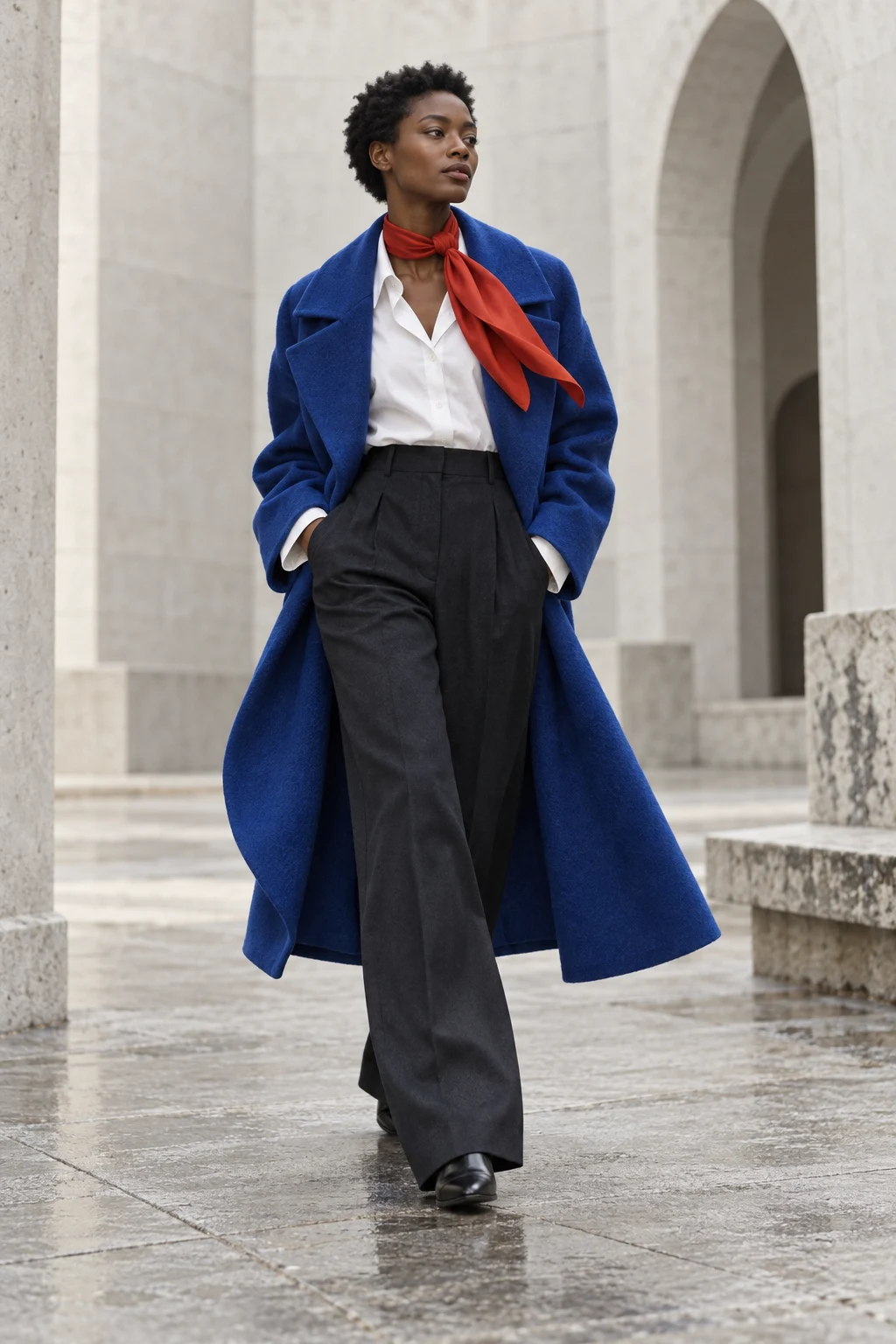
Burgundy and navy offer a way to build a dark outfit with more than one colour. The effect can be subtle enough that you notice the relationship only when the light changes. That subtlety is part of the appeal, but it can also make the combination difficult to judge in photographs.
Choose the area that should lead
For a navy-led outfit, imagine a navy suit with a burgundy top visible beneath the jacket. For a burgundy-led version, imagine a burgundy dress with navy outerwear. The same colour names produce different impressions because the visible areas are not equal.
These are outfit proposals, not statements about what qualifies for a particular event. An invitation’s dress code and the actual garments still matter.
Use surface to keep the pair legible
A matte navy fabric beside a more reflective burgundy can create separation even when both are dark. Alternatively, use a textured knit against a smooth woven surface. Avoid assuming that the brighter-looking area is a lighter colour; it may simply be catching more light.
What to do with accessories
- Repeat one of the two colours for a continuous effect.
- Use a small metallic detail if you want a precise highlight.
- Introduce a pale element near the face if the overall darkness feels heavier than intended.
Try one of these at a time. If a necklace, bag, shoe and belt all demand attention, the original colour pairing may become a background you barely notice.
Check the outfit in its intended light
Look at the combination in ordinary indoor light as well as daylight. A deep blue can appear almost black in a dim room, and a dark red may lose its distinction. If the pair disappears completely, use a slightly clearer shade or a larger textural contrast.
The goal is not a strict formula for sophistication. It is a deliberate relationship you can actually see and enjoy. Our metallic styling guide explores how a small reflective area can change that relationship.