A purple silk dress dated to the 1860s seems to offer an easy caption: mauve, the new synthetic colour that became fashionable after William Henry Perkin’s 1856 discovery. The timing fits. The colour appears to fit. Yet neither observation proves which dye is in the fibres.
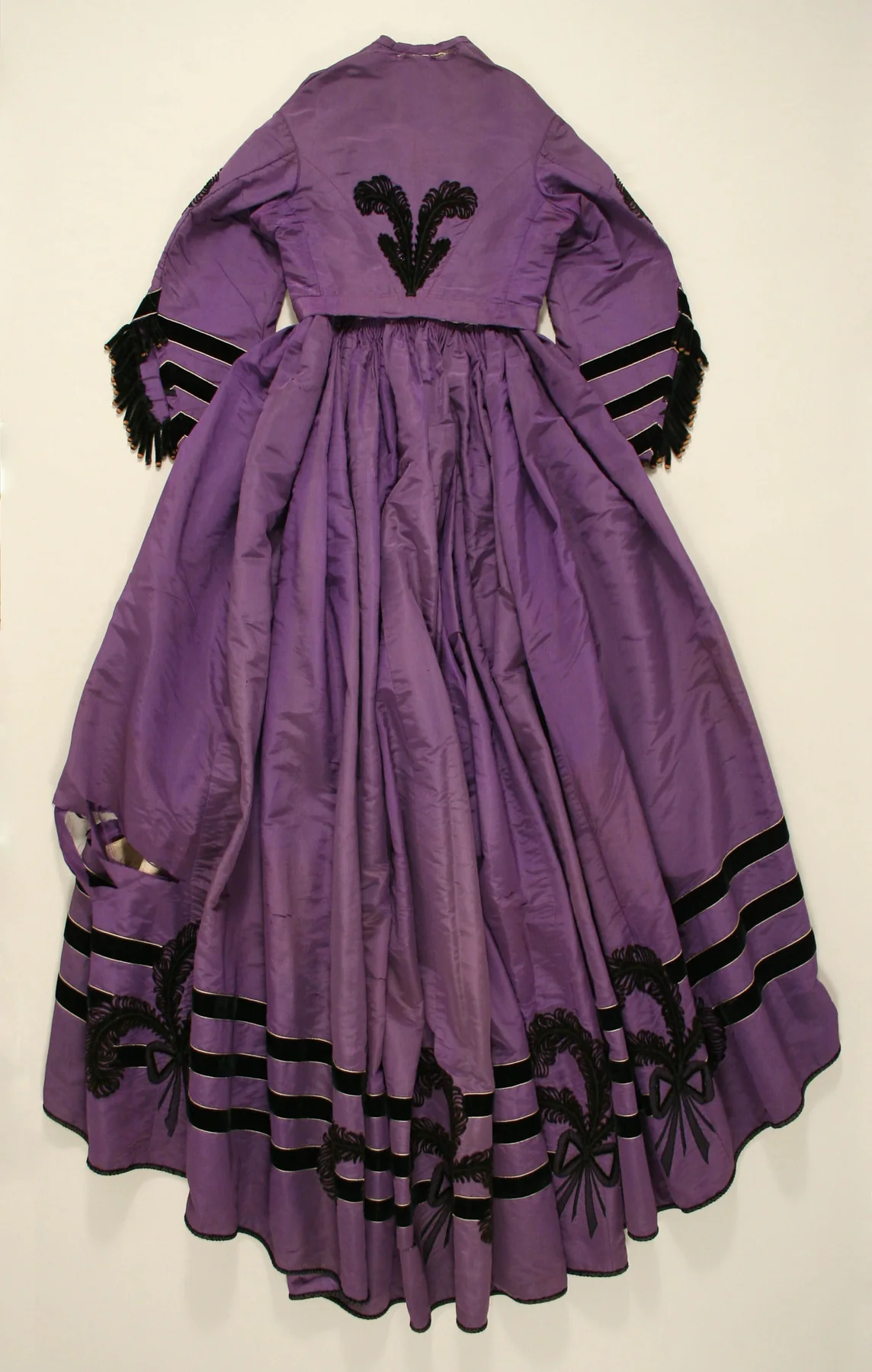
The European afternoon dress pictured above is dated to about 1863 by The Metropolitan Museum of Art. The museum identifies its material as silk and releases the object photograph as Public Domain, but its catalogue entry does not name a dye. It is therefore an illustration of period colour, not a confirmed mauveine garment. That distinction is more than museum caution: it changes how fashion history should be read.
Mauve and mauveine are related, not interchangeable
Today, mauve is a flexible colour word. It can describe many muted purples, pinkish violets or greyed lilacs. Mauveine is the name attached to the synthetic dye Perkin developed from aniline chemistry. A textile can look mauve without containing mauveine, and a fabric originally dyed with mauveine may no longer show exactly the colour it had when new.
The Science Museum Group records that Perkin was trying to synthesise quinine in 1856 when his experiment produced a dark substance. Dissolved in alcohol, part of that material made a purple solution that dyed silk. Its collection includes an English silk skirt and blouse from 1862–63 specifically described as dyed with Perkin’s mauve aniline dye. That is a much stronger identification than assigning a dye from a digital image.
The breakthrough was a system, not simply a shade
Natural purple dyes existed long before the 1850s. What made Perkin’s work consequential was the route from laboratory residue to patent, factory production and textile use. The Science Museum Group dates his patent for a new lilac or purple colouring matter to 26 August 1856 and notes that Perkin and Sons was supplying mauve to silk dyers by December 1857.
The V&A places the dye within a wider transformation of dress production. Its history of Victorian underwear identifies aniline purple—later called mauve—as one of several mid-century innovations, alongside sewing machines and the cage crinoline. Synthetic colours did not arrive in isolation: new materials, manufacturing methods and understructures were changing what garments looked like and how many could be produced.
This context also prevents an overly tidy invention story. Mauveine was an important early commercial synthetic dye, but it prompted further experiments and was followed by other synthetic purples and a rapidly expanding range of colours. A fashionable purple dress from the period could therefore involve more than one plausible colourant.
Why the surviving colour is not a chemical label
Colour changes with fibre, dye recipe, concentration, finishing, wear, washing, storage and light. The Science Museum’s confirmed mauveine outfit is visibly faded, and its catalogue notes that early artificial colours could be impermanent. The colour on a screen adds another layer: museum lighting, camera settings and display calibration all mediate what the viewer sees.
A Metropolitan Museum technical study makes the identification problem especially clear. Discussing late-19th-century textiles, its authors note that only a small number of historic fabrics had been confirmed as mauveine through analysis. The point is not that visual looking is useless. Hue, date and provenance can guide a question. They cannot finish the chemical test.
For the afternoon dress above, the disciplined description is therefore modest: European silk, about 1863, photographed as a purplish dress. Calling it “mauveine” would add a fact the catalogue does not supply. The image remains relevant because it demonstrates the exact temptation the article is asking readers to resist.
How to read colour claims in a museum catalogue
- Separate the object description from your impression. “Purple silk” describes appearance and material. “Dyed with mauveine” identifies a colouring substance.
- Look for the basis of the identification. A catalogue may cite maker records, provenance, an inscription or scientific analysis. If it does not, treat a chemical name as unconfirmed.
- Check whether the photograph is illustrative. A neighbouring garment from the same decade can explain silhouette or colour context without representing the same dye, maker or wearer.
- Expect the present colour to have a history. Fading is evidence of change, not a transparent view of the garment on its first day.
The same method helps with contemporary shopping. A colour name on a product page is not a fibre or dye specification. Compare the garment under different light, read the material and care labels, and accept that a poetic shade name is primarily a communication tool. For experiments in balancing purples with other colours, continue through Runway Note’s colour combinations reading route.
A better story than “purple was invented”
Perkin did not invent purple, and one discovery did not turn every purple dress into a mauveine dress. His achievement was to demonstrate that a commercially useful textile colour could emerge from synthetic organic chemistry and be manufactured at scale. Fashion became both a market for that chemistry and a highly visible way to advertise it.
The careful version of the story is richer because it keeps three things in view at once: the colour people saw, the substance dyers used and the industrial network that connected laboratory, factory and wardrobe. When a museum record confirms all three, mauveine becomes a precise material history. When it confirms only a purple appearance, the honest label is still purple—and the open question is part of the object’s story.
Sources & further looking
Science Museum Group — Silk skirt and blouse dyed with Perkin's mauve aniline dyeV&A — Corsets, crinolines and bustles: fashionable Victorian underwearThe Metropolitan Museum of Art — Afternoon dress, ca. 1863Metropolitan Museum Journal — A Technical Study of Sargent's Mrs. Hugh Hammersley and Her DressHistorical, material and collection references are linked above. Styling exercises and interpretations are our editorial suggestions.
Continue with the colour guides, or read our editorial policy.